Credit: UMaine
Advanced 3D printing and digital engineering at the University of Maine’s Advanced Structures and Composites Center (ASCC) are helping tackle one of the nuclear industry’s toughest challenges: building infrastructure that is faster, cheaper, and smarter.
When California-based Kairos Power set out to construct its next-generation Hermes nuclear reactor, it encountered a familiar obstacle. Traditional building methods were too slow, too costly, and too inflexible to meet the project’s ambitious schedule.
The reactor required enormous concrete radiation-shielding walls—each 3 feet thick, 27 feet tall, and shaped with a complex sinusoidal curve. Conventional construction simply couldn’t produce these components efficiently or with the required precision.
That’s when the University of Maine stepped in.
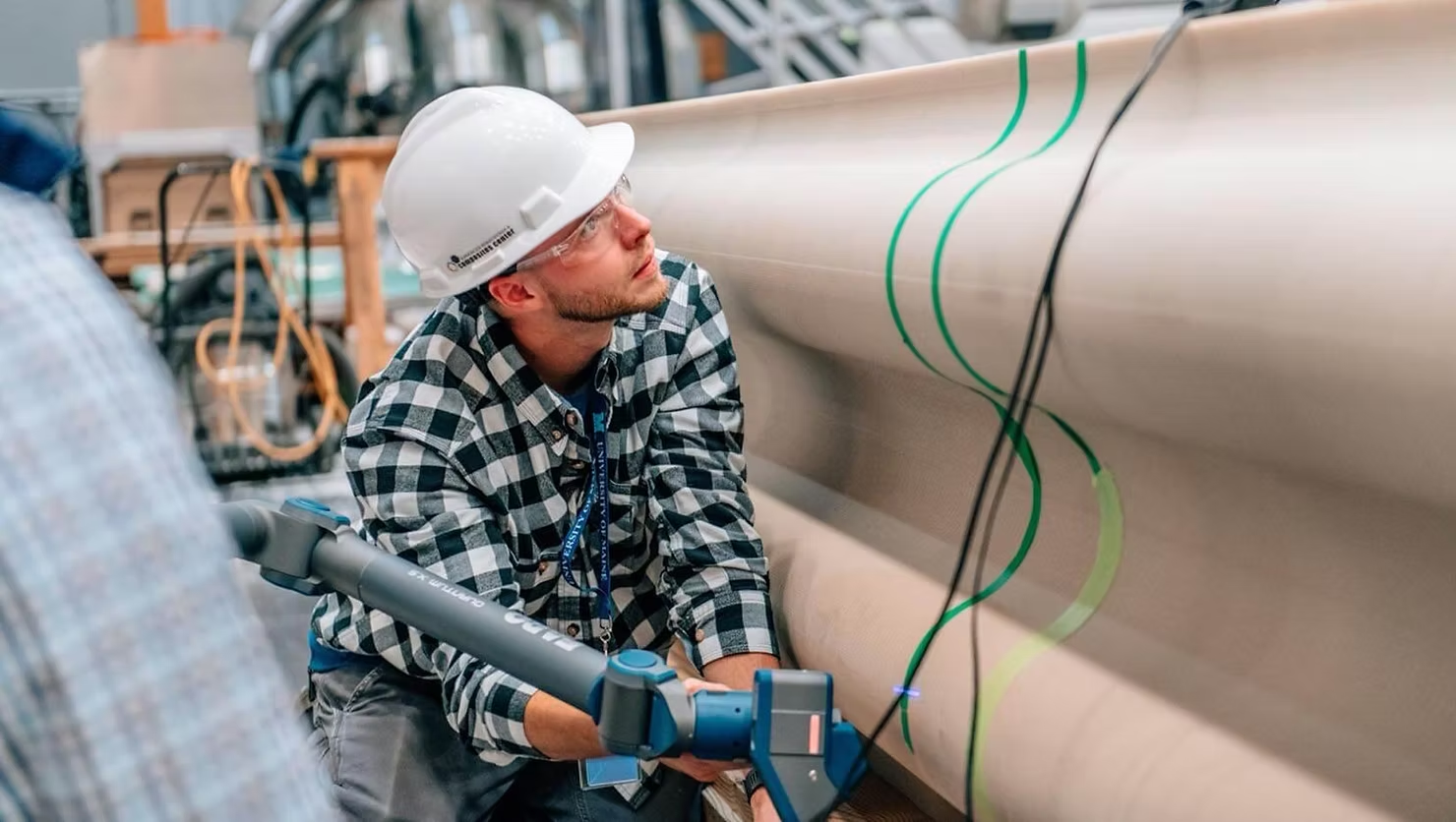
Engineers at UMaine’s ASCC designed and 3D-printed advanced sinusoidal concrete form liners that could be fitted into a steel frame, creating a hybrid casting system that dramatically accelerated production and reduced costs. This innovation kept the Kairos project moving forward and showcased how large-scale additive manufacturing could redefine the future of American energy infrastructure.
READ ALSO: https://www.modernmechanics24.com/post/rhesus-monkey-aging-map-organ-secrets
“There was no margin for error. We delivered massive, high-precision components on a commercial deadline — something unprecedented for an academic center,” said Susan MacKay, ASCC’s chief sustainable materials officer. “This collaboration proves that UMaine is truly working at industry speed.”
The ASCC houses the world’s largest polymer 3D printer, capable of producing hundreds of pounds of material per hour. That industrial-scale capability enables the university to meet timelines typically associated with private-sector manufacturing — a rare strength for a research institution.
This effort is part of the Specialized Materials and Manufacturing Alliance for Resilient Technologies (SM²ART), a public-private partnership designed to solve industrial challenges, cut manufacturing costs, and work with locally sourced materials. The alliance brings together the University of Maine, the Department of Energy’s Oak Ridge National Laboratory (ORNL), and industry partners.
WATCH ALSO: https://www.modernmechanics24.com/post/china-40000t-sichuan-assault-ship
“UMaine is showing how universities and national labs can work together to strengthen U.S. manufacturing,” said Ryan Dehoff, director of DOE’s Manufacturing Demonstration Facility at ORNL. “SM²ART gives industry direct access to the tools and talent needed to build the next generation of energy and defense infrastructure.”
Nuclear power has long been a pillar of U.S. energy security, supplying decades of reliable, carbon-free electricity. But construction delays and high costs continue to slow the rollout of new reactors — a pressing concern as AI data centers and other emerging technologies drive unprecedented power demand.
Following ORNL’s recommendation, Kairos turned to UMaine for a solution that could meet commercial timelines without compromising precision. ASCC engineers produced the longest 3D-printed forms ever created at the center and used advanced machining to achieve tight tolerances. A dedicated scanning and metrology team then verified every curve and contour against digital models to ensure exacting quality standards.
READ ALSO: https://www.modernmechanics24.com/post/2nd-bomb-wing-calibration-lab-upgrade
“This project was possible thanks to ASCC’s leadership in large-scale additive and convergent manufacturing, composite materials, and structural engineering — combined with a business model built around industry needs,” said ASCC Executive Director Habib Dagher. “It’s a level of performance rarely seen in academia, and it’s vital as the U.S. works to modernize its energy infrastructure.”
UMaine is also advancing digital manufacturing assurance through its Material Process Property Warehouse (MPPW). Using AI and machine learning, the system creates a complete “digital thread” of the manufacturing process, allowing components to be “born certified.” This innovation reduces regulatory delays, cuts costs, and lowers industry risk — especially for nuclear and defense applications.
The project further strengthens UMaine’s role in workforce development. Students, graduate researchers, and industry professionals collaborate directly on real-world, high-impact projects in advanced manufacturing, energy, and national security — preparing a skilled workforce for the industries of tomorrow.
WATCH ALSO: https://www.modernmechanics24.com/post/worlds-first-flying-car-factory-china
While Kairos Power’s immediate focus is nuclear energy, the implications of UMaine’s work reach far beyond. The same rapid, large-scale manufacturing and digital assurance can support advancements in defense systems, transportation infrastructure, housing, and even AI data centers.
For Kairos, UMaine’s innovation solved a critical construction challenge. For the nation, it demonstrated how cutting-edge work happening in Maine is helping build the future — faster, smarter, and more efficiently than ever before.
READ ALSO: https://www.modernmechanics24.com/post/neurips-nvidia-digital-physical-ai