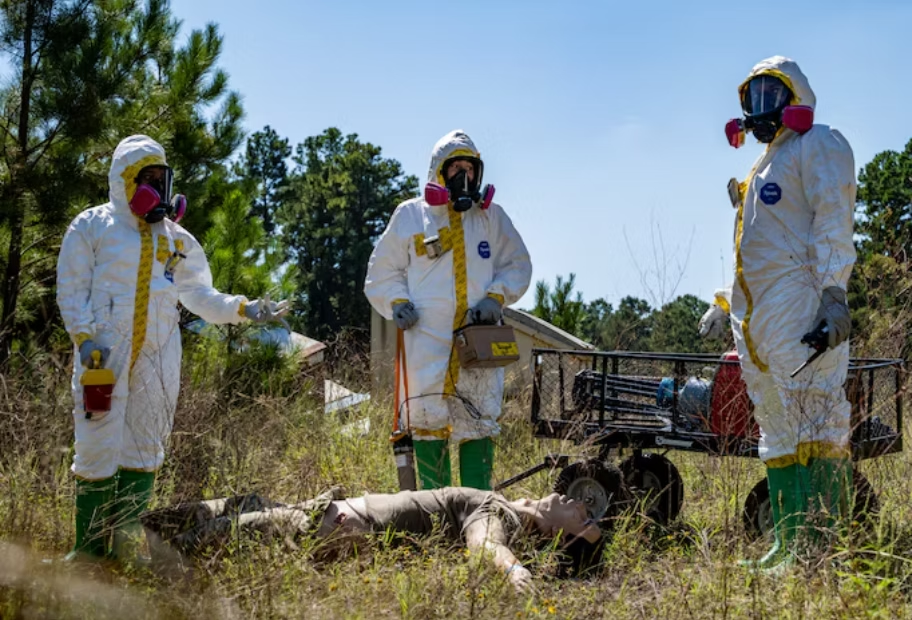
Credit: Airman 1st Class Devyn Taylor
Barksdale Air Force Base is establishing a certified calibration lab for Ludlum radiation meters, making it the only base in Air Force Global Strike Command (AFGSC) with this capability and one of two across the Department of Defense. The lab will reduce calibration time from weeks to 24 hours, enabling faster health risk assessments during nuclear incidents, according to Master Sgt.
Brandon Thompson, 2nd Operational Medical Readiness Squadron bioenvironmental engineering flight chief, who initiated the project after identifying efficiency needs during Immediate Response Force (IRF) and Response Task Force (RTF) exercises.
Barksdale Air Force Base is on track to establish a certified calibration lab for Ludlum radiation meters, making it the only base in Air Force Global Strike Command with this capability and one of two across the Department of Defense. Ludlum Measurements, based in Sweetwater, Texas, manufactures radiation detection and monitoring equipment used by the Department of Energy, the Air Force Radiation Assessment Team and national defense missions.
These meters detect alpha, beta and gamma radiation. A certified calibration lab at Barksdale will allow faster, more precise health risk assessments, giving commanders the information they need to make informed decisions during nuclear incidents and health emergencies.
READ ALSO: https://www.modernmechanics24.com/post/high-velocity-ejection-test-by-drdo
The initiative began when U.S. Air Force Master Sgt. Brandon Thompson, 2nd Operational Medical Readiness Squadron bioenvironmental engineering flight chief, identified the need for more efficient calibration capability for radiation response exercises.
“When I came from the 711th Human Performance Wing, I was on the Air Force Radiation Assessment Team as a certified calibrator,” Thompson said. “Once I got in the shop and started participating in Immediate Response Force and Response Task Force exercises, I saw a potential to explore a scaled-down version of the calibration lab located in the U.S. Air Force School of Aerospace Medicine, at Wright-Patterson Air Force Base in Ohio.”
Barksdale has worked closely with Wright-Patterson AFB to develop standard operating procedures and acquire specialized equipment. The U.S. Air Force School of Aerospace Medicine has guided Barksdale’s Bioenvironmental Engineering Flight through the certification process, helping the base focus resources on essential requirements.
WATCH ALSO: https://www.modernmechanics24.com/post/tron1-hyper-real-dinosaur-robot
Once certified, the lab will allow Barksdale to conduct calibrations within 24 hours, instead of sending the meters to the Ludlum manufacturer and waiting weeks for the calibrations to be sent back. This would also enable Barksdale to acquire meters from other AFGSC bases and reduce reliance on external labs.
“That rapid turnaround will only be possible if Airmen are fully trained on the equipment,” said 1st Lt. Krystal Torres Diaz, 2nd Medical Group executive officer. “Training ensures our Airmen are ready to step in the moment certification is complete.
Doing sets and reps ensures confidence and repeatability in calibrations. It’s about making sure the capability is not only available, but also effective.”
The Bioenvironmental Engineering Flight’s leadership team will host a capstone evaluation for their Airmen. The capstone is designed to prepare Airmen to confidently operate Ludlum meters, resolve issues in the field and deliver accurate information to commanders.
READ ALSO: https://www.modernmechanics24.com/post/bruce-power-siemens-energy-turbine-deal
“Having the opportunity to train on radiation equipment that emergency responders around the world use is truly a unique experience,” said Airman 1st Class Raeven Anthony, 2nd OMRS bioenvironmental engineering technician. “This gives us the edge that no other bioenvironmental engineering flight in the DoD has.”
The capability addresses a critical operational gap in nuclear response readiness. Currently, AFGSC bases must ship radiation detection equipment to the manufacturer in Sweetwater, Texas, creating multi-week delays that could prove problematic during actual nuclear incidents or exercises requiring rapid equipment validation.
The 24-hour turnaround transforms operational planning. Instead of maintaining large inventories of meters to account for equipment in calibration pipelines, Barksdale can operate leaner while ensuring instruments remain accurate and mission-ready. This efficiency extends beyond the base itself, as other AFGSC installations can send their meters to Barksdale for faster service than manufacturer turnaround provides.
The radiation meters detect alpha, beta, and gamma radiation—the three primary types of ionizing radiation with different penetration capabilities and health hazards.
WATCH ALSO: https://www.modernmechanics24.com/post/byd-seal-smooth-electric-power
Alpha particles stop easily but prove dangerous if inhaled or ingested. Beta particles penetrate skin but are blocked by protective clothing. Gamma rays require dense shielding like lead or thick concrete, making them the most challenging to protect against.
Accurate meter calibration proves critical because radiation exposure decisions depend on precise measurements. Commanders must balance mission requirements against health risks, making decisions about evacuation, protective equipment requirements, and safe exposure durations. Miscalibrated meters could lead to either unnecessary mission delays or dangerous radiation exposures.
The Immediate Response Force and Response Task Force missions that inspired Thompson’s initiative represent AFGSC’s nuclear incident response capabilities. These teams deploy rapidly to nuclear accidents, weapons incidents, or radiological emergencies, requiring reliable detection equipment that can provide immediate, accurate radiation level assessments.
READ ALSO: https://www.modernmechanics24.com/post/mono-rail-arunachal-army-innovation-16000ft
Thompson’s background with the Air Force Radiation Assessment Team and 711th Human Performance Wing provided the technical expertise necessary to identify feasible solutions. Rather than attempting to replicate the full capabilities of the U.S. Air Force School of Aerospace Medicine’s laboratory at Wright-Patterson AFB, he recognized that a scaled-down version could meet Barksdale’s specific operational requirements.
The training emphasis highlighted by 1st Lt. Torres Diaz addresses human factors that often determine whether technical capabilities translate into operational effectiveness. Equipment alone doesn’t create capability—trained personnel who can operate systems confidently and troubleshoot problems under pressure make the difference between theoretical and practical readiness.
Airman Anthony’s observation about the unique opportunity reflects the specialized nature of radiation detection expertise. While many career fields offer broadly applicable skills, bioenvironmental engineering—particularly radiation measurement and calibration—represents niche technical knowledge with limited civilian equivalents outside nuclear power, medical physics, and specialized industrial applications.
WATCH ALSO: https://www.modernmechanics24.com/post/china-humanoid-robot-plays-basketball
The Bioenvironmental Engineering Flight will use this certification to strengthen the 2nd Bomb Wing’s IRF and RTF missions, delivering faster, more reliable information to commanders, Airmen and interagency partners tasked with safeguarding the nation.