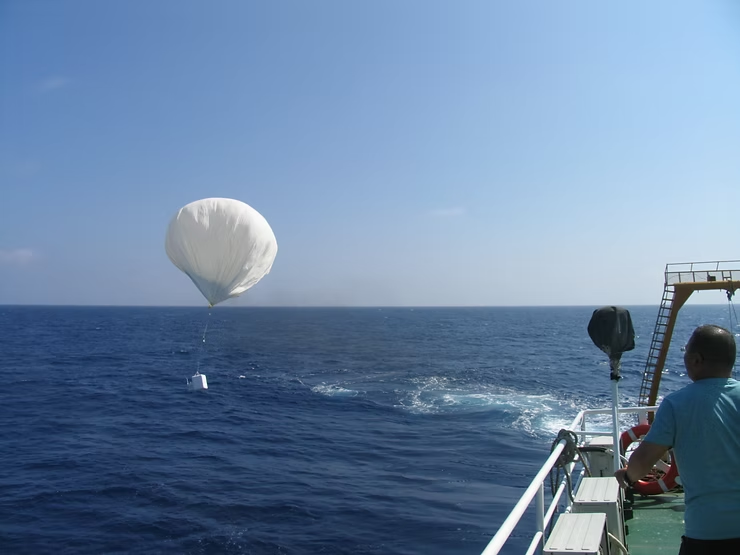
As human activity across the world’s oceans continues to expand, scientists are paying closer attention to changes in atmospheric composition—especially ozone, a key component of marine atmospheric chemistry. In a groundbreaking effort, researchers have carried out China’s first shipborne ozone-sounding campaign in the South China Sea, producing high-resolution data that fills a critical gap in understanding oceanic ozone dynamics.
The project was conducted in collaboration with the Nansha Marine Ecological and Environmental Research Station and CAS’s South China Sea Institute of Oceanology. The campaign, held in May and June 2023, represents the first time such detailed ozone measurements have been systematically collected over China’s oceanic regions.
Why Study Marine Ozone?
Ozone in the troposphere—the lowest layer of the atmosphere—is a major secondary pollutant. Its levels are shaped by photochemical reactions, emissions from natural and human sources, and atmospheric circulation. Over the oceans, the chemistry differs significantly: marine air has unique physical and chemical properties, and the ocean itself acts as a major sink for ozone.
While China has operated long-term ozone-sounding programs over land, comparable efforts over the ocean—particularly the ecologically and climatologically important South China Sea—had been lacking until this study.
READ ALSO: World’s first sea-skimming drone can enter enemy areas autonomously
READ ALSO: World’s Most Precise Clock Just Got an Upgrade, Thanks to NIST
The shipborne measurements revealed several important patterns:
- Higher-than-expected summer ozone levels: Ozone concentrations in the South China Sea’s boundary layer (the atmosphere’s lowest part) were higher than those typically observed at other tropical marine sites.
- Fine vertical detail: Compared with satellite and reanalysis data, which often smooth out variability, the shipborne soundings captured much more detailed vertical ozone structures.
- Impact of typhoons: Strong convection associated with typhoons caused a sharp decline in ozone mixing ratios in the upper troposphere (around 13.5 km altitude). Conversely, subsidence near the tropopause slightly increased ozone concentrations in the mid-troposphere.
These results underscore how regional meteorological processes directly influence ozone distribution in marine environments.
READ ALSO: Ocean Buddies: Dolphins and Whales Love to Play Together
READ ALSO: China’s BYD EV withstands 3 successive lightning strikes
A Step Toward Long-Term Monitoring
“This experiment not only confirms the feasibility of shipborne ozone soundings in marine environments but also provides key observational data for studying ozone distribution over coastal and offshore regions,” said Dr. Li Dan, the study’s lead author.
The team aims to expand shipborne observations and build a long-term ozone monitoring network covering the full range from the ocean surface to the stratosphere. Such a system would greatly enhance scientific understanding of ocean-atmosphere interactions while supporting broader global efforts to track climate change and air quality trends.