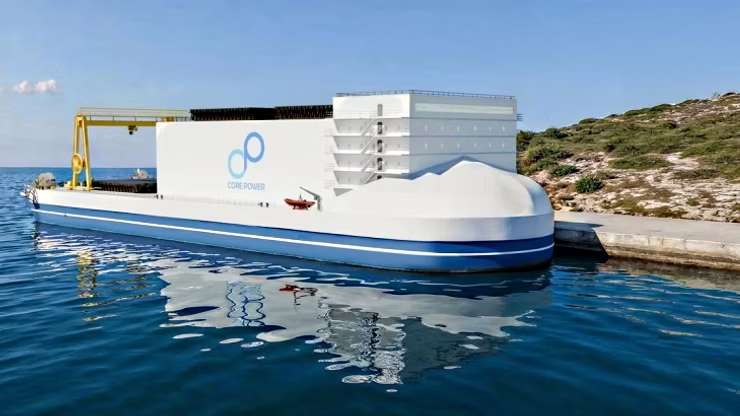
In a groundbreaking move that could redefine how nuclear power is delivered, a coalition of energy and maritime leaders is setting its sights on the Mediterranean Sea. The American Bureau of Shipping (ABS), Core Power of the UK, and newly formed Greek company Athlos Energy have announced a joint effort to explore the potential of deploying floating nuclear power plants—or FNPPs—across key coastal regions and islands.
The initiative is designed to tackle some of the most persistent energy challenges in the Mediterranean, from power shortages on isolated islands to the carbon-heavy operations of major seaports. According to the consortium, FNPPs could also help solve a growing humanitarian problem: the lack of fresh water in drought-prone coastal communities. These mobile reactors could provide clean, constant power to desalination plants, turning seawater into drinking water with zero emissions.
The full scope of this ambitious project was first outlined by World Nuclear News, which reported that the three companies will jointly assess how FNPPs might serve multiple roles—power generation, water purification, and carbon-free energy supply—especially in remote or underserved parts of the region.
Core Power emphasized the cross-sector impact that floating nuclear technology could offer. The company noted that nuclear energy is uniquely positioned to support a range of industries—including electricity, shipping, transport, and desalination—while also enhancing grid reliability and helping nations meet their climate targets. FNPPs, they say, could bridge the energy gaps that conventional infrastructure can’t.
One major advantage of floating nuclear reactors is their ability to be constructed and assembled entirely in shipyards, allowing for faster and more cost-efficient rollout. These ships can then be deployed wherever needed, eliminating the long delays and risks often associated with building land-based nuclear facilities. This modularity could prove especially valuable in areas vulnerable to political uncertainty or natural disasters.
READ ALSO: Solutions+ and Serco Join Forces to Create a Leading National Player in Facilities Management
READ ALSO: Philosophers Endorse New Test to Guide Moral Decisions in Driverless Cars
In October 2024, ABS took a decisive step forward by publishing the world’s first set of comprehensive technical and safety requirements for FNPPs. With these guidelines in place, the new partnership will now proceed to model operational scenarios and identify feasible deployment zones—focusing initially on the Aegean Sea and broader Mediterranean basin.
To guide this evaluation, the ABS Global Ship Systems Centre will conduct a PESTLE analysis—a detailed study of the political, economic, social, technological, legal, and environmental factors affecting floating nuclear deployment. Input from local governments, marine regulators, and environmental agencies will play a key role. The outcome will be a publicly available white paper intended for policymakers, researchers, and industry stakeholders.
For Core Power CEO Mikal Bøe, floating nuclear represents not just a clean energy solution, but a fundamentally new way of thinking about nuclear power deployment. “By constructing and mass-assembling a fleet of FNPPs in shipyards, we can deliver clean nuclear energy on time and on budget, solving many of the largest energy challenges we face,” Bøe said. “Core Power is delighted to partner with ABS and Athlos Energy on this vital initiative.”
Greece’s participation adds a politically significant dimension to the project. Although Greece has historically not pursued nuclear energy, the energy crisis and rising demand for clean power are forcing a national reconsideration. Dionysios Chionis, co-founder of Athlos Energy, believes the country’s geography and energy profile make it an ideal testing ground. “As Greece reconsiders its energy future, the role of nuclear power is increasingly back on the agenda,” Chionis said. “This study marks an important first step in assessing the feasibility of deploying floating nuclear reactors in the Aegean Sea.”
ABS Chairman and CEO Christopher Wiernicki sees FNPPs as a timely solution in the global energy transition. He pointed out that floating reactors could power everything from ports and microgrids to industrial hubs and data centers. “As global efforts accelerate to reduce emissions, improve energy efficiencies and strengthen energy security, the use of small modular reactors on floating platforms could offer a viable alternative,” Wiernicki said.
READ ALSO: Future USS Jeremiah Denton launched by HII’s Ingalls Shipbuilding
READ ALSO: Eco friendly, inexpensive system for storing high-power energy from pine biomass
This collaboration follows Core Power’s earlier announcement of its Liberty programme—an ambitious two-phase plan to bring FNPPs to market by the mid-2030s. The first phase involves the mass production of floating plants designed for stationary power generation. In the second phase, the company aims to develop full nuclear propulsion systems for commercial maritime vessels.
Liberty will be anchored in the United States and rely on advanced technologies such as molten salt reactors, known for their safety, stability, and compact design. These next-generation reactors could be the key to making nuclear energy viable not just on land, but at sea and even onboard working ships.
Core Power has also teamed up with nuclear giant Westinghouse in a separate agreement to design FNPPs using the company’s innovative eVinci microreactor. The eVinci system employs heat pipe technology and is designed for autonomous, low-maintenance operation—making it a strong candidate for maritime applications. Together, the two firms will also work on establishing a global regulatory path for floating nuclear licensing, which remains one of the major challenges in scaling the technology. Reported world nuclear news
As the world continues to wrestle with climate goals and energy shortages, FNPPs could emerge as a flexible and deployable solution that doesn’t require vast tracts of land or long-term local construction. Instead, shipyards could produce compact, self-contained nuclear units ready to deliver clean power anywhere on the map.
For the Mediterranean, a region facing rising temperatures, mounting water scarcity, and growing energy needs, the study’s findings could mark a turning point. Whether deployed to provide power to Greek islands, supply energy to desalination plants in North Africa, or decarbonize industrial ports in Italy or Turkey, floating nuclear reactors may offer a path to both climate resilience and energy independence.
The upcoming white paper, expected to be released by the ABS-Core Power-Athlos consortium, could become a reference point not only for the Mediterranean but for coastal nations around the world. If successful, FNPPs might soon become an emblem of the clean energy era—delivering nuclear power not from the land, but from the sea.