China is developing its second space situational awareness constellation, Xingyan (Star Eye), with 156 satellites designed to track orbital objects and provide collision warnings every two hours, according to Hu Yu, chairman of Xingtu Cekong.
The Anhui-based developer, a spin-off of Zhongke Xingtu, plans to launch 12 satellites by 2027 with full network operation after 2028, following China’s Kaiyun-1 launch in September for the 24-satellite Guangshi constellation operated by Beijing Kaiyun United.
China is launching a second satellite constellation to monitor objects in orbit to help commercial operators lower collision risks and ease the country’s long reliance on foreign tracking data.
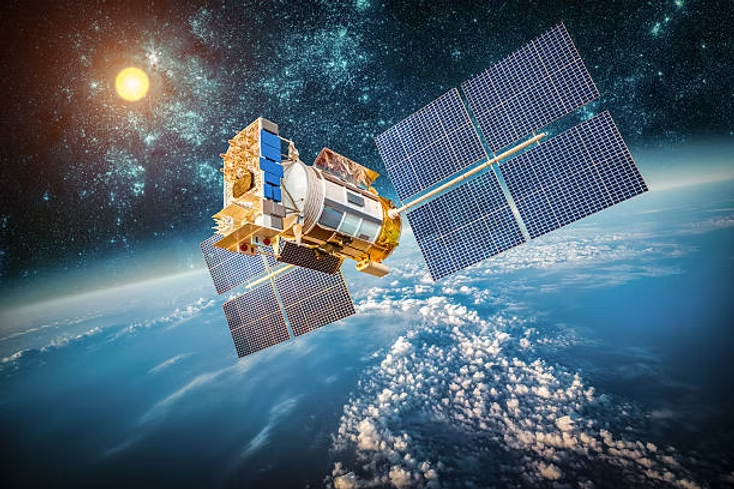
When complete, the Xingyan – or Star Eye – space situational awareness constellation will have 156 satellites up and running to identify the orbits of other satellites and debris, detect unusual movements, and provide collision warnings and maneuver advice every two hours.
Its developer, Xingtu Cekong, an Anhui-based spin-off of leading geospatial data company Zhongke Xingtu, said 12 satellites would be launched by 2027 and the full network in operation after 2028.
READ ALSO: https://www.modernmechanics24.com/post/ai-tech-helps-blind-users-feel-objects
The network will deliver 30-minute updates, with global low-orbit coverage and targeted monitoring in higher orbits, Xingtu Cekong chairman and project leader Hu Yu said in Beijing on Thursday.
China launched Kaiyun-1, the first satellite of the Guangshi space situational awareness constellation, in September. That system will be operated by Beijing Kaiyun United, another Zhongke Xingtu spin-off, and comprise 24 satellites.
So far, the only fully operational network is the U.S. military’s Geosynchronous Space Situational Awareness Programme, which uses five active satellites in geosynchronous orbit to monitor other spacecraft and investigate unusual activity.
The concept of space situational awareness took shape in the 1990s to detect and track objects in orbit—from active satellites to pieces of debris—and predict their movements.
It relies on networks of ground-based radars and telescopes as well as space-based sensors that watch activity in low and high orbits. With thousands of new satellites launched each year, these systems have become essential for managing traffic and avoiding collisions.
WATCH ALSO: https://www.modernmechanics24.com/post/china-humanoid-robot-plays-basketball
The technology is widely considered dual use: the same data that help commercial operators steer clear of debris can also reveal the behavior of foreign satellites, flag unusual maneuvers and support military planning.
Hu, from Xingtu Cekong, said Xingyan was designed to support commercial space activity. He said each satellite would carry a mix of cameras and sensors, including wide-field, infrared and multispectral imagers, electromagnetic monitors and onboard processors, and use AI to detect risks and support automated collision-avoidance.
Once the satellites detected debris and other objects in orbit, they would determine their positions and send the data to the ground for processing, he said.
“After the data is processed, we will send the resulting strategies back up to the satellites so they can avoid collisions and eventually protect space assets,” Hu said.
The project will roll out in two phases—an initial backbone of 12 high-performance satellites, followed by 144 lower-cost satellites to boost coverage. Two test satellites are planned for launch in the first half of next year, according to Hu.
READ ALSO: https://www.modernmechanics24.com/post/china-scientific-satellites-cosmic-discoveries
The expanding orbital infrastructure comes as space becomes increasingly congested. Thousands of satellites now circle Earth, with private companies like SpaceX launching massive constellations for communications and internet services. This growth has dramatically increased collision risks—even small pieces of debris traveling at orbital velocities can destroy operational satellites.
China’s investment in dual space situational awareness constellations reflects both commercial and strategic priorities. The Xingyan network’s 156 satellites will provide far more comprehensive coverage than the U.S. military’s five-satellite system, though the American network focuses on higher geosynchronous orbits where the most valuable communications and reconnaissance satellites operate.
The 30-minute update cycle represents a significant improvement over ground-based tracking systems, which often provide less frequent data and have coverage gaps. Space-based sensors can continuously monitor orbital activity without atmospheric interference or geographic limitations.
WATCH ALSO: https://www.modernmechanics24.com/post/us-marines-seaglider-rescue-showcase
The AI-powered collision avoidance capability could prove particularly valuable as satellite operators struggle to coordinate movements among thousands of spacecraft from different countries and companies. Automated systems that can detect potential collisions and recommend maneuvers in near real-time may become essential for safe space operations.
China’s approach of developing two separate constellations—Xingyan’s 156 satellites and Guangshi’s 24 satellites—suggests different missions or operational requirements. The smaller Guangshi network may focus on specific orbital regions or provide higher-resolution tracking of priority targets, while Xingyan offers broader coverage.
Beyond China, other commercial operators are getting into the game, including California-based Turion Space, which started launching dedicated space situational awareness satellites about two years ago. This growing commercial sector reflects recognition that space traffic management will require extensive sensor networks operated by multiple entities.
READ ALSO: https://www.modernmechanics24.com/post/ai-data-centers-solo-reactor-100-unit-plan
The dual-use nature of space situational awareness technology complicates international cooperation. While collision warnings benefit all space operators, the same systems can track military satellites and support anti-satellite operations. This tension between transparency for safety and secrecy for security will likely shape how nations share orbital tracking data.