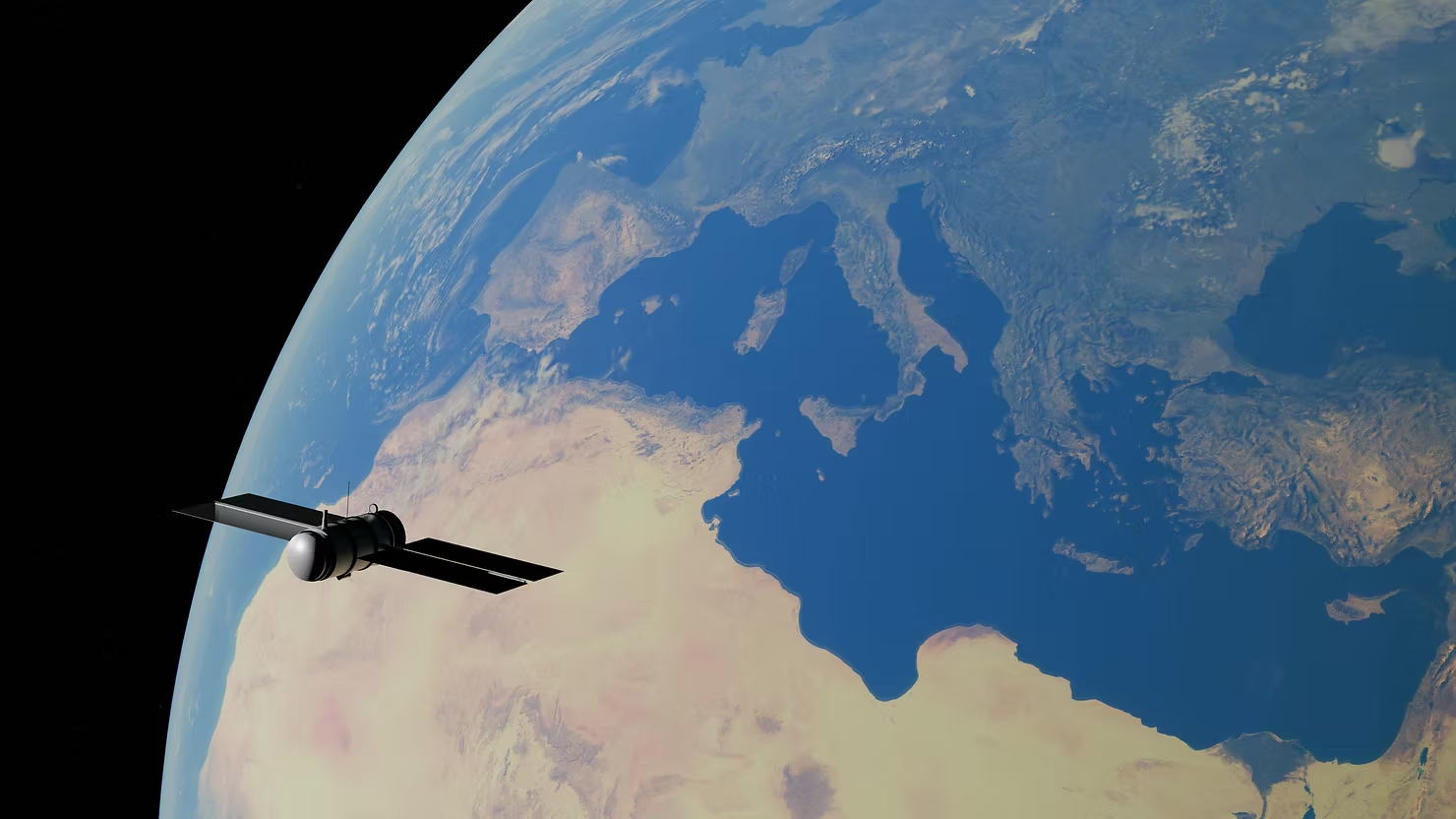
China’s series of scientific satellites has achieved groundbreaking discoveries across cosmic phenomena, including transient celestial objects, cosmic-ray propagation, and solar eruptions, offering humanity a renewed perspective on the universe.
Focusing on fundamental questions such as the origin of the universe, the nature of space weather, and the emergence of life, China plans to launch and operate a series of advanced scientific satellite missions during its 15th Five-Year Plan period (2026–2030).
These missions aim to explore the cosmic dark age, track solar magnetic activity cycles, and detect Earth-like exoplanets, according to Wang Chi, academician of the Chinese Academy of Sciences (CAS) and director general of its National Space Science Center.
“Through these missions, China will continue delivering key, original, and leading scientific achievements, advancing the country’s capabilities in space science, technology, and applications,” Wang said.
READ ALSO: https://www.modernmechanics24.com/post/robot-to-build-ev-hyundai-plant
Since the launch of the CAS space science program in 2011, China has deployed eight scientific satellites, including the Dark Matter Particle Explorer (DAMPE), Shijian-10 retrievable satellite, Quantum Experiments at Space Scale (QUESS), Hard X-ray Modulation Telescope (Insight-HXMT), Taiji-1, Gravitational Wave High-energy Electromagnetic Counterpart All-sky Monitor (GECAM), Advanced Space-based Solar Observatory (ASO-S), and the Einstein Probe (EP).
On a grand scale, the program produced the world’s first all-sky X-ray map. At the microscopic level, it delivered the most precise measurements yet of cosmic-ray electrons, protons, helium, and boron nuclei.
Chinese satellites have directly measured the universe’s strongest magnetic field and observed the fastest jets near black holes. These missions exemplify a high degree of integration between science, technology, and engineering.
WATCH ALSO: https://www.modernmechanics24.com/post/saturn-rings-vanish-but-cosmic-glitch-reveals-truth
The program has also driven technological leaps in satellite platforms and payloads. China has mastered satellite-to-ground optical-link alignment, integrated satellite platform and payload design, and developed the world-leading large-field, high-sensitivity lobster-eye X-ray telescope.
International collaboration is a key feature. The Solar wind Magnetosphere Ionosphere Link Explorer (SMILE) satellite represents the first comprehensive, full-lifecycle partnership between CAS and the European Space Agency (ESA).
The EP satellite, led by China with ESA, Germany, and France participation, marks the ESA’s first role as an “opportunity mission” partner in a Chinese space science project, fostering data sharing and multinational science teams.
READ ALSO: https://www.modernmechanics24.com/post/r2s-1-25b-tamir-contract-camden
The EP mission has discovered new X-ray transient sources, including EP241021a, offering insights into elusive cosmic events. Insight-HXMT has advanced understanding of black-hole outbursts, neutron star nuclear burning, and gamma-ray bursts.
GECAM revealed a new subclass of gamma-ray bursts from compact-object mergers, while DAMPE uncovered unique cosmic-ray structures, deepening knowledge of particle propagation. Observations from ASO-S are shedding light on solar eruptions and high-energy particle origins.
Experts worldwide have praised China’s achievements. Samuel Krucker of Switzerland noted ASO-S’s unique contributions to solar science, while Andrea Santangelo of Germany predicted China will become a global leader in high-energy astrophysics within the next decade. “China has emerged as a reliable and committed actor in space science, oriented toward scientific success and innovation,” he said.
WATCH ALSO: https://www.modernmechanics24.com/post/chinese-company-new-humanlike-robot