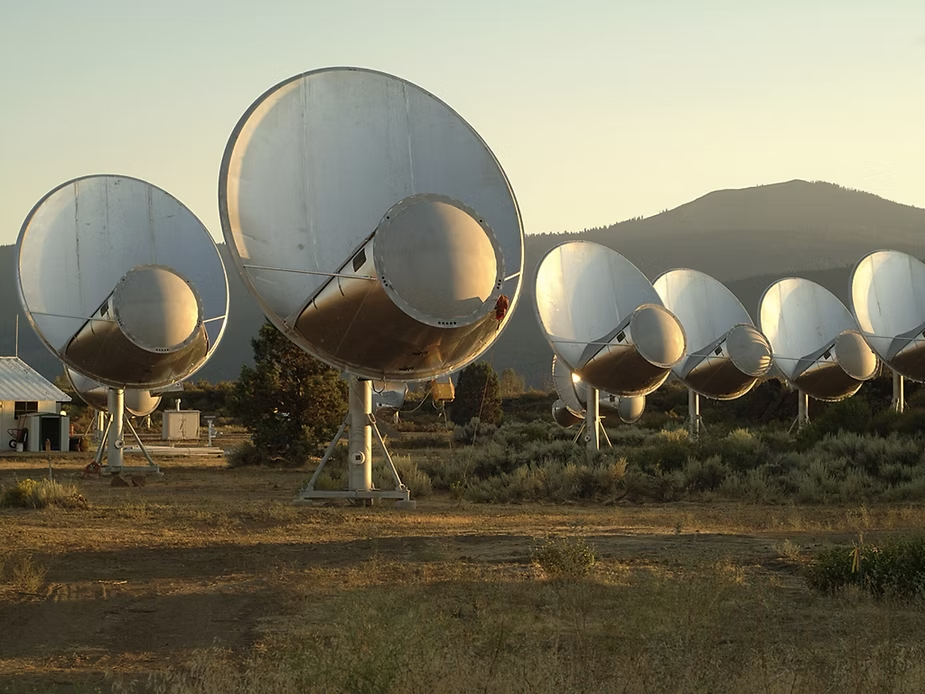
Sometimes the most extraordinary discoveries happen by accident. Astronomers using the Allen Telescope Array just watched something that’s never been unambiguously observed before – a massive black hole hiding thousands of light-years from where it should be, revealing itself only because it happened to shred a passing star.
This cosmic murder mystery, officially designated AT 2024tvd, represents a breakthrough in understanding how supermassive black holes can lurk in unexpected corners of the universe, invisible until something dramatic gives away their location.
Here’s what makes this discovery so remarkable. When astronomers detect tidal disruption events – the technical term for what happens when a star wanders too close to a supermassive black hole and gets torn apart by gravitational forces – they almost always occur at the centers of galaxies. That’s where these cosmic monsters typically live, anchoring galactic cores with masses millions or billions times greater than our sun.
AT 2024tvd broke that pattern spectacularly. The event occurred twenty-six hundred light-years offset from its galaxy’s center, revealing a hidden supermassive black hole that nobody knew existed in that location.
“Tidal disruption events are usually found at the hearts of galaxies whereas AT 2024tvd was caused by an off-center black hole, the first time this has been unambiguously seen,” explained Dr. Joe Bright, Radio Astronomy Researcher at the University of Oxford. “It’s possible that the unprecedented rapid radio evolution is the result of its unusual position in the galaxy.”
READ ALSO: https://www.modernmechanics24.com/post/bmw-motorrad-proudly-introduces-the-all-new-bmw-r-1300-r
The discovery was led by Dr. Itai Sfaradi and Dr. Raffaella Margutti of the University of California, Berkeley, working with an international team including astronomers from the SETI Institute. What they found challenges assumptions about where massive black holes can hide.
Most galaxies, including our Milky Way, host a supermassive black hole at their core. These gravitational behemoths pull in surrounding material and launch enormous jets that fundamentally shape galactic evolution. But not all supermassive black holes announce their presence loudly. Many remain quiet and essentially invisible until something dramatic occurs nearby.
That’s where tidal disruption events become invaluable. When a black hole tears apart a star, the resulting chaos lights up the cosmos across all wavelengths – visible light, X-rays, and radio waves. Scientists can use these catastrophic events to probe black hole properties and discover hidden monsters in unusual locations.
WATCH ALSO: https://www.modernmechanics24.com/post/robotic-skin-helps-tiny-robots-navigate
Radio observations of AT 2024tvd revealed something unexpected. The host galaxy doesn’t have just one supermassive black hole – it has two. One sits at the expected location at the galaxy’s center, while the second lurks offset by those twenty-six hundred light-years. This wandering black hole is likely the remnant of an ancient galactic merger, when two separate galaxies collided and their central black holes ended up in the same cosmic neighborhood.
When this off-center black hole encountered an unlucky star that strayed too close, the resulting shredding produced two rapid and powerful bursts of radio emission. These signals gave scientists an unprecedented look at how black holes behave outside traditional galactic centers.
“What makes this discovery even more remarkable is that it reveals a massive black hole that would otherwise be invisible to us,” said Dr. Margutti. “The only reason we can detect this wandering black hole is because it happened to tear apart a star and produce these incredibly bright radio signals.”
The Allen Telescope Array played a crucial role in tracking this event. Dr. Sofia Sheikh, Technosignature Research Scientist at the SETI Institute, emphasized the array’s unique capabilities: “The ATA provided precise and time-sensitive radio measurements that helped astronomers track the event’s radio brightness as it rose and faded over time. The ATA’s ability to monitor changing signals from space – quickly, flexibly, and over a broad range of frequencies – made it uniquely suited to capturing the fast-evolving nature of AT 2024tvd.”
What made AT 2024tvd particularly unusual was its speed. The event evolved at record-breaking pace, developing faster than any previously observed tidal disruption. Scientists suspect this rapid evolution might result directly from the black hole’s unusual position away from the galactic nucleus.
Beyond revealing hidden black holes, the radio observations provide compelling clues about what happened to the disrupted star. Detailed modeling of the radio evolution, including data from the ATA, reveals that this cataclysmic event launched two separate outflows. The first likely contained remnants of the shredded star – essentially stellar debris ejected at tremendous speeds.
Imagine what the star experienced in its final moments. As it approached the black hole, gravitational forces became increasingly uneven – astronomers call this differential tidal stress. The side closer to the black hole felt substantially stronger pull than the far side. Eventually these forces exceeded the star’s own gravity holding it together, and it was literally pulled apart like taffy.
The disrupted material didn’t simply fall into the black hole. Some formed an accretion disk swirling around the black hole, heating to millions of degrees and radiating across multiple wavelengths. Other material got flung outward in those powerful jets detected by radio telescopes.
WATCH ALSO: https://www.modernmechanics24.com/post/rafael-launches-new-loitering-weapon-system
This discovery demonstrates the ATA’s growing importance in time-domain astronomy – the study of rapidly changing cosmic phenomena including tidal disruption events, fast radio bursts, and supernovae. Unlike telescopes that observe single targets for long periods, time-domain astronomy requires monitoring large swaths of sky to catch transient events as they happen.
The implications extend beyond this single event. If supermassive black holes can hide thousands of light-years from galactic centers, how many others are out there lurking undetected? Galactic mergers throughout cosmic history likely scattered these monsters across unexpected locations. Most remain invisible until they encounter passing stars.
AT 2024tvd proves that sometimes the universe’s most significant secrets only reveal themselves through violence and destruction – a star’s terrible fate becoming our window into cosmic mysteries.