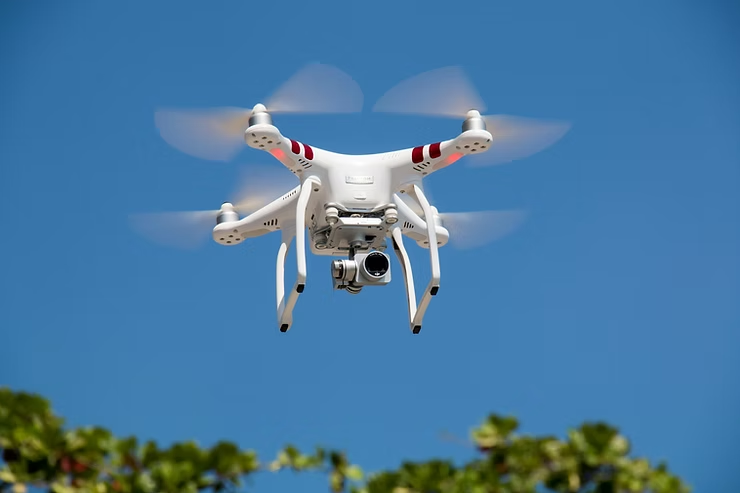
Imagine a drone that doesn’t wait for human commands — it flies, spots danger, and decides what to do all by itself. That’s exactly what two American companies are now working on.
U.S. defense company RTX and tech startup Shield AI have teamed up to create smart, AI-powered weapons and systems. Their goal is to build drones and sensors that don’t need constant control from people. Instead, they’ll use artificial intelligence (AI) to understand their mission, spot threats, and take action — on their own.
The brains behind this technology is Shield AI’s software called Hivemind. It acts like a digital pilot. With Hivemind, a drone can fly without GPS, internet, or a remote control. It can navigate dangerous places, avoid obstacles, and complete missions without help. Now, RTX plans to install Hivemind into its loitering munitions (drones that wait before attacking) and advanced targeting systems.
One of the most exciting parts of the partnership is something called Networked Collaborative Autonomy (NCA). This means multiple drones or machines will be able to work together as a team, sharing information and making joint decisions — just like a group of soldiers would do.
Another big point: this entire project is privately funded. Usually, military technology is developed with government money. But this time, RTX and Shield AI are investing their own money — which shows how serious they are about this future.
Chris Calio, CEO of RTX, said in a statement (reported by Business Wire), “AI and autonomy are improving the performance of our products. With Shield AI, we’ll deliver powerful new tools for our customers.”
READ ALSO: New OTSM Technique Enables 3D Imaging of Floating Live Cells
READ ALSO: Discovery of a ‘mini halo’ offers new clues about the formation of the early universe
READ ALSO: The world’s largest solar-powered vehicle carrier successfully completes its first voyage
Gary Steele, CEO of Shield AI, added, “This partnership shows how the defense world is changing. By combining AI with top-quality hardware, we’re creating smart new solutions for national security.”
But it’s not just about flying smarter drones. The two companies are also working to improve sensors — the equipment that helps military systems detect and track targets. Shield AI’s software called ViDAR (Visual Detection and Ranging) will be added to RTX’s existing Multi-Spectral Targeting System (MTS).
This upgrade will allow military systems to automatically spot threats like drone swarms or fast-moving boats and respond quickly — without waiting for human input. These smarter sensors could save critical seconds in high-pressure situations.
Shield AI’s technology has already proven itself. Its V-BAT drone can take off vertically and fly for long periods without any manual control. That same AI is now being brought into other RTX products, helping make more of their systems fully autonomous.
The companies have also made it clear that they will follow strict rules for using AI in defense. They’re working in line with the U.S. Department of Defense’s guidelines, which say that AI in military systems must be safe, secure, traceable, and always under human oversight.
The new AI-powered systems are already being developed for use by RTX’s existing military customers — especially the U.S. forces already using MTS sensors. That means we won’t have to wait long before these smart tools are actually used in the field.
This partnership shows how quickly defense is changing. RTX, a company known for building missiles, radars, and planes, is now stepping into the world of smart, software-driven warfare. Shield AI is bringing the intelligence — and together, they’re building weapons that think, sense, and act faster than ever before.
These machines aren’t meant to replace people — they’re designed to help them. When threats come faster than humans can react, AI-powered tools could make all the difference.