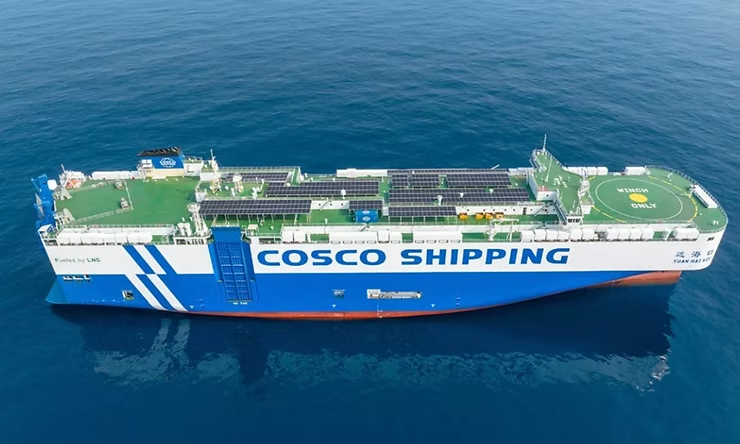
In a landmark moment for sustainable shipping, China’s COSCO Shipping Corporation has successfully completed the maiden voyage of the “Yuanhai Kou,” the world’s largest photovoltaic (PV) powered vehicle carrier ship. As reported by Science and Technology Daily on Friday, the vessel docked at the car carrier terminal of Greece’s Piraeus Port carrying 4,000 Chinese-made vehicles. This historic journey isn’t just about the sheer size of the ship or the number of cars it delivered — it marks a new era in maritime logistics where clean energy meets smart technology to reshape the global transport of vehicles.
The “Yuanhai Kou” is an engineering marvel, measuring 199.9 meters in length with a gross tonnage of 68,252 tons and a displacement of 39,069 tons. It features 12 vehicle decks, including eight fixed decks and four movable ones, giving it a total carrying capacity of 7,000 standard car parking spaces. The vessel is built to handle all types of vehicles, from passenger cars to engineering machines and large buses. But what truly sets it apart is its clean power system, led by the most powerful shipborne photovoltaic system ever deployed on a car carrier. With a peak output of 302.8 kilowatts, the onboard solar array generates approximately 410,000 kilowatt-hours of electricity annually. This clean energy is directly used onboard, contributing to lower carbon emissions and fuel consumption.
According to the Science and Technology Daily report, the vessel achieves a 35 percent reduction in lifecycle carbon intensity compared to conventional car carriers. This is primarily due to its hybrid propulsion system that combines liquefied natural gas (LNG) with traditional fuel oil. The LNG-compatible engine enables a 20 percent increase in energy efficiency and over 24 percent reduction in carbon emissions on a single voyage. A typical round-trip between China and Europe using the “Yuanhai Kou” results in an impressive reduction of 2,100 tons of carbon dioxide emissions. These savings are significant in a global industry where emissions from large cargo ships are notoriously difficult to curb.
READ ALSO: Huawei’s 3,000km Solid-State Battery with 5-Minute Charge Sparks Industry Race
READ ALSO: German tech gives precise temperature of electric motor, can boost EV range
In addition to its clean energy features, the “Yuanhai Kou” integrates smart technology designed for both safety and efficiency. The ship is equipped with China’s first independently developed real-time vehicle loading software specifically for car and truck carrier ships. This system allows for real-time vehicle tracking during transport, which is critical for managing the logistics of such high volumes of cargo. It also features a fire early-warning mechanism — a vital feature given the increasing number of new energy vehicles (NEVs), such as electric and hybrid cars, being transported, which come with unique safety risks. By using intelligent software to monitor cargo and maintain fire safety protocols, COSCO Shipping has ensured that this vessel not only moves clean but also operates smart.
The arrival of the “Yuanhai Kou” in Greece is more than a technological milestone; it’s a strong signal of China’s ambition to lead the next wave of environmentally responsible global shipping. As the world’s largest vehicle exporter, China is increasingly relying on green shipping infrastructure to support its booming exports of electric vehicles and other clean technologies. Ships like the “Yuanhai Kou” are becoming strategic assets, not just for logistics efficiency but also as tools of soft power and environmental diplomacy. The ability to deliver thousands of NEVs to global markets using a vessel powered by solar energy and LNG enhances China’s credibility in both sustainable technology and international trade. Reported Globat Times
READ ALSO: Fusion power could be a step closer to reality with Cambridge research
READ ALSO: One of UK’s largest Iron Age hoards unearthed in North Yorkshire
The successful completion of this maiden voyage sets a new benchmark for the shipping industry. As regulatory pressure grows worldwide to cut maritime emissions, the “Yuanhai Kou” stands as a practical, operational example of how solar power, hybrid fuel systems, and digital technologies can be integrated into real-world logistics. While the maritime sector still faces massive challenges on the path to full decarbonization, this vessel proves that impactful change is possible today — not just in theory, but in practice.
By bridging green energy and smart logistics, the “Yuanhai Kou” represents the beginning of a transformation that could redefine how the world moves goods across oceans. Its presence in Greece marks not just the end of a journey, but the beginning of a much larger voyage — one where solar-powered giants may soon become the new normal in ports around the world.