Hydrogen-producing hydrothermal systems are among the rarest features of the deep ocean, but they hold outsized importance for science. These unique environments not only shed light on Earth’s inner workings but may also reveal the chemical conditions that once fostered the very origins of life. Now, researchers from the Institute of Oceanology of the Chinese Academy of Sciences (IOCAS) have announced the discovery of one of the most extraordinary examples yet: a massive hydrogen-rich hydrothermal system lying beneath the western Pacific seafloor.
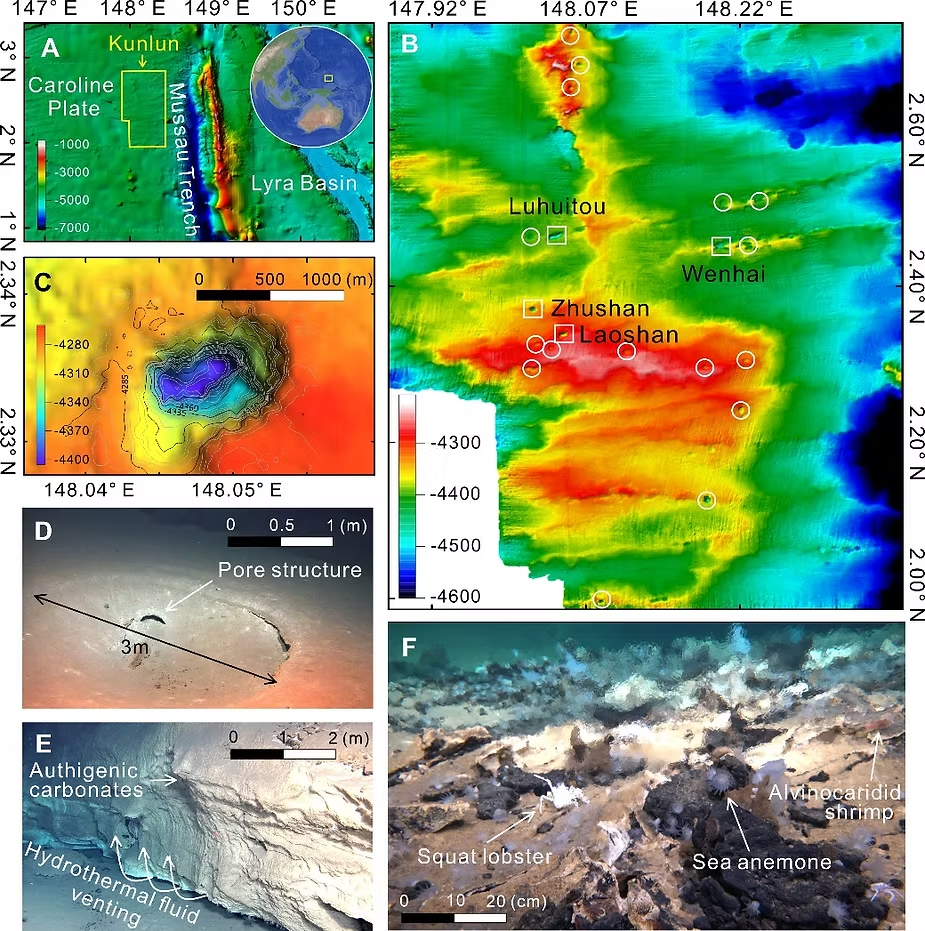
The newly identified Kunlun hydrothermal field, located about 80 kilometers west of the Mussau Trench on the Caroline Plate, is unlike anything scientists have seen before. This tectonically active area is made up of 20 huge seafloor depressions—some more than a kilometer across—clustered together in a formation resembling a “pipe swarm.”
Such structures act as conduits, channeling fluids and gases upward from deep inside Earth. To investigate this mysterious site, scientists used the Fendouzhe crewed submersible, which allowed them to carry out in situ exploration and gather direct measurements.
What they found was remarkable. The system emits abundant hydrogen-rich fluids and features vast carbonate deposits, all located below the so-called carbonate compensation depth—the ocean depth at which carbonate minerals typically dissolve. This makes the discovery even more unusual, as such deposits are rarely preserved at these depths.
READ ALSO: The Case of the Missing Sulfur: Chemists Find Answers in Space
READ ALSO: What Do Ice Volcanoes Look Like? Scientists Just Recreated Them on Earth
“The Kunlun system stands out for its exceptionally high hydrogen flux, scale, and unique geological setting,” explained Prof. Sun Weidong, the study’s corresponding author. “It demonstrates that serpentinization-driven hydrogen generation can occur far from mid-ocean ridges, overturning long-standing assumptions.”
Serpentinization is a process in which magnesium- and iron-rich rocks deep beneath the seafloor react chemically with water, producing serpentine minerals and releasing hydrogen gas. Until now, most scientists believed that large-scale hydrogen release through serpentinization was confined to mid-ocean ridges. The Kunlun discovery challenges that belief.
Using advanced seafloor Raman spectroscopy, the research team measured hydrogen concentrations of 5.9–6.8 mmol/kg in the diffuse hydrothermal fluids. Although these fluids were relatively cool—below 40°C—chemical markers revealed evidence of much higher subsurface temperatures, hot enough to drive dolomite formation. This suggests vigorous water–rock interactions happening deep underground.
READ ALSO: https://www.modernmechanics24.com/post/hu
READ ALSO: Fruit flies are a crucial inspiration for the field of robotics.
Even more striking are the sheer quantities of hydrogen produced. Based on discharge mapping and flow velocity analysis, the researchers estimate that the Kunlun field releases 4.8 × 10¹¹ mol of hydrogen per year. That figure represents at least five percent of the global abiotic hydrogen output from all submarine sources—an extraordinary contribution from a single system.
The geological structures surrounding Kunlun tell the story of its complex evolution. Steep-walled craters resembling kimberlite pipes, deposits of fragmented rock known as breccias, and layered carbonate formations all suggest that the field began with explosive, gas-driven eruptions. Over time, this activity transitioned into sustained hydrothermal circulation and mineral deposition, creating today’s dynamic seafloor landscape.
The discovery also carries major implications for deep-sea ecosystems. Researchers observed a thriving community of organisms in the area, including shrimp, squat lobsters, tubeworms, and anemones. These creatures may rely on hydrogen-based chemosynthesis—a process in which microbes convert hydrogen and other chemicals into energy, forming the foundation of unique food webs independent of sunlight.
“What’s particularly fascinating is the ecological potential,” Prof. Sun noted. “These hydrogen-rich environments may provide a refuge for life forms that are entirely dependent on chemical energy.”
READ ALSO: One of UK’s largest Iron Age hoards unearthed in North Yorkshire
READ ALSO: Electric vehicles and their warning sounds are hard to detect when moving at low speeds
For scientists studying life’s origins, the Kunlun hydrothermal field offers an invaluable natural laboratory. The alkaline, hydrogen-rich fluids here may closely resemble the conditions of early Earth, when primitive microbial life first emerged. This makes Kunlun not only a geological wonder but also a window into humanity’s deepest biological history.
Beyond fundamental science, the discovery has potential practical significance. Submarine hydrogen systems such as Kunlun could one day be explored as natural energy resources, offering new avenues for renewable energy research.
In short, the Kunlun hydrothermal system is rewriting what scientists thought they knew about hydrogen production in the deep sea. It highlights the powerful role of serpentinization far from traditional ridge settings, reveals rich ecosystems powered by chemical energy, and strengthens the connection between modern hydrothermal vents and the ancient origins of life.
As researchers continue to study Kunlun, it may not only expand our knowledge of Earth’s hidden processes but also guide future explorations for untapped hydrogen resources beneath the ocean floor.