Scientists have recreated the extreme environments of icy moons, uncovering water’s volatile behavior under deep space conditions. In the near-vacuum conditions of space, water behaves very differently than it does on Earth—boiling and freezing at the same time.
Many icy moons are encased in a frozen shell, beneath which lie vast subsurface oceans. Much like volcanic activity reshapes Earth’s landscape with molten lava, these moons experience a process called cryovolcanism, where water plays a similar geological role.
To explore how these unusual behaviors of water might influence the geology of icy moons, scientists from the University of Sheffield, the Open University, and the Czech Academy of Sciences constructed a specialized low-pressure chamber. This setup mimics the near-zero atmospheric conditions found on moons such as Europa and Enceladus.
Europa, one of Jupiter’s moons, and Enceladus, which orbits Saturn, both have frozen outer layers. On Enceladus, equatorial temperatures drop as low as -193°C. Astronomers have detected powerful plumes of water vapor and ice particles being explosively ejected into space—a phenomenon known as explosive cryovolcanism.
A related but subtler process, called effusive cryovolcanism, involves liquid water flowing across the moon’s surface in a manner similar to lava on Earth. However, direct evidence of this type of activity remains difficult to observe.
The research team set out to investigate how effusive cryovolcanism might occur by examining how water behaves in a near-vacuum environment. Their findings are detailed in the journal Earth and Planetary Science Letters.
READ ALSO: An innovative system for large-scale production of high-performance metals
READ ALSO: Northrop Grumman Successfully Tests World’s Most Powerful Rocket Booster for NASA Moon Missions
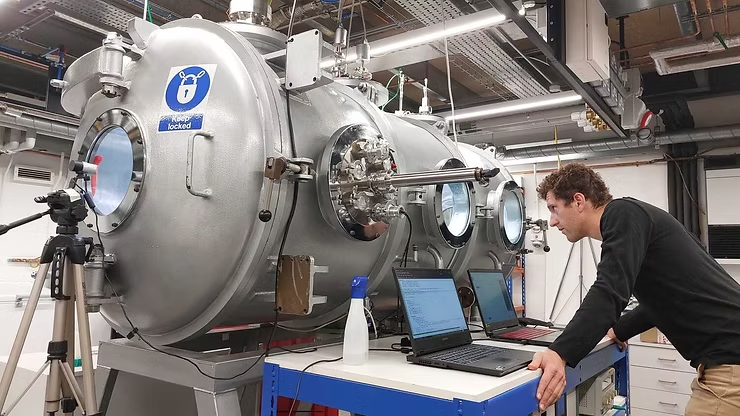
To conduct the experiments, they used a low-pressure chamber known as “George”—the Large Dirty Mars Chamber—located at the Open University. For the first time, scientists were able to work with relatively large volumes of water in such a setup, capturing the process on video through observation ports.
As the pressure inside the chamber dropped, the cold water began to boil and bubble. This boiling produced vapor, which carried heat away from the water, causing it to cool further. Eventually, the temperature dropped to the freezing point, and floating ice crystals began to form. These ice fragments gradually expanded as more ice developed around their edges.
Within just a few minutes, a thin layer of ice had spread across most of the water’s surface.
Beneath the thin ice layer, the remaining liquid water continued to boil. Bubbles pushed against the ice, sometimes distorting or breaking through it, allowing small amounts of water to escape onto the surface through cracks. Previous research using smaller amounts of water had suggested that thick ice would quickly form and seal off the liquid, halting further boiling.
READ ALSO: New quantum sensing technology reveals subatomic signals
READ ALSO: New “one-pot” technique a breakthrough for material synthesis
Dr. Frances Butcher, Research Fellow in the School of Geography and Planning at the University of Sheffield and co-author of the study, explained: “The ice that forms is fragile, riddled with bubbles and gaps.
“If the ice were more robust, it would likely trap the liquid water underneath and stop the boiling process. But in our experiments, boiling water released gas that became trapped beneath the icy crust. As pressure built up, the ice eventually cracked, allowing the gas to escape and letting small amounts of water seep through to the surface—where it was once again exposed to the vacuum-like conditions.
“Each time a new fracture formed, the water would start boiling again, causing the cycle to repeat.” Unlike on Earth—where water freezes at 0 °C and boils at 100 °C—space conditions trigger both processes simultaneously in a dramatic and dynamic display.
Dr. Petr Brož, lead author of the study and a researcher at the Institute of Geophysics, Czech Academy of Sciences, explained that freezing water in extremely low-pressure environments is far more intricate than previously understood.
“In these conditions, water boils rapidly even at low temperatures because it becomes unstable under low pressure,” he said. “At the same time, it evaporates and starts to freeze, driven by the intense cooling that results from evaporation. The ice crust that forms doesn’t remain intact—instead, it’s repeatedly broken by vapor bubbles rising beneath the surface, which lift and crack the ice. This constant disruption slows, complicates, and extends the freezing process.”
The team hopes their findings will aid in identifying evidence of past cryovolcanic activity not only on icy moons but also on other bodies throughout the Solar System. The bubbling process observed during the experiments caused the ice surface to become uneven, forming ridges and dips across the crust.
Manish Patel, Professor of Planetary Science at the Open University and supervisor of the Mars simulation facility, explained that the surface irregularities—formed by vapor trapped beneath the ice—could leave detectable marks. “These features might be picked up by orbiting spacecraft, particularly those using radar systems, potentially offering a new method for spotting evidence of past cryovolcanic activity,” he said.
He added that such findings could be crucial for shaping future exploration missions to these distant celestial bodies and could deepen our understanding of the still-enigmatic phenomenon of cryovolcanism. The study received funding from the Czech Science Foundation.