Credit: Yang et al., Chem Circularity
Chemical engineer Professor Jin Xuan and a team from the University of Surrey are sounding the alarm on the environmental cost of the space boom. In a new roadmap published in the journal Chem Circularity, they argue for applying Earth’s “reduce, reuse, recycle” principles to spacecraft, calling for a systemic shift toward a “circular space economy” to ensure long-term sustainability.
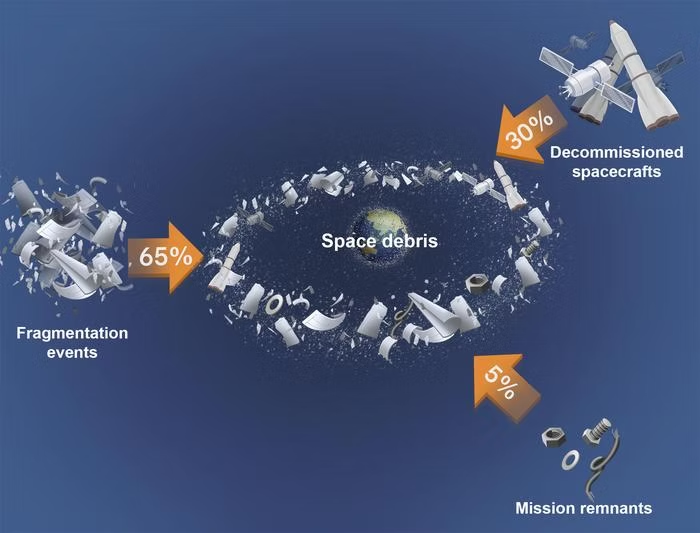
Every rocket launch is a spectacle of human achievement, but it also carries a hidden environmental ledger. Tons of materials are expended, greenhouse gases are released, and eventually, defunct satellites become hazardous orbital debris. With private space launches accelerating, scientists warn this “take-make-discard” model is unsustainable. Now, researchers led by Professor Jin Xuan, a chemical engineer at the University of Surrey, are publishing a revolutionary blueprint to clean up our act beyond Earth’s atmosphere.
In a perspective piece published in the journal Chem Circularity, the team lays out a comprehensive strategy for applying circular economy thinking to the final frontier. “As space activity accelerates, from mega-constellations of satellites to future lunar and Mars missions, we must make sure exploration doesn’t repeat the mistakes made on Earth,” says senior author Professor Jin Xuan. “A truly sustainable space future starts with technologies, materials and systems working together.”
The current model is starkly linear and wasteful. Satellites are designed for single use, and decommissioned craft are either abandoned in “graveyard orbits” or become dangerous space junk. The University of Surrey team argues this is not viable for the coming era of massive satellite constellations and deep-space exploration.
READ ALSO:https://www.modernmechanics24.com/post/mit-artificial-tendons-robot-boost
Their solution is a fundamental paradigm shift. “Our motivation was to bring the conversation about circularity into the space domain, where it’s long overdue,” Xuan states. “Circular economy thinking is transforming materials and manufacturing on Earth, but it’s rarely applied to satellites, rockets, or space habitats.”
The roadmap is built on adapting the classic three Rs for the cosmos. First, reduce. This means designing satellites and spacecraft for greater durability and in-orbit repairability. The authors suggest that future space stations could be repurposed as orbital hubs for refueling, repairing, and even manufacturing components, drastically cutting down on the number of launches needed from Earth.
Second, reuse. To enable this, the sector must invest in technologies like parachutes and airbags for soft-landing systems, allowing hardware to be recovered intact. The authors caution, reported in their Chem Circularity article, that any components intended for reuse would need to pass extreme safety tests due to the wear-and-tear of the space environment.
WATCH ALSO: https://www.modernmechanics24.com/post/most-distant-spacecraft-one-light-day-away
Third, recycle. This involves active orbital debris recovery using nets, robotic arms, or other capture technologies. Reclaimed materials could be reprocessed in orbit, turning today’s space junk into tomorrow’s satellite parts. The authors emphasize that preventing collisions through debris removal is as critical as recycling the materials themselves.
Crucially, the team highlights that data and digital tech will be the nervous system of this new economy. AI systems could be used to optimize spacecraft trajectories to avoid debris, while advanced simulations could reduce the need for resource-heavy physical testing. Analyzing performance data from aging hardware could also inform better, longer-lasting designs.
Achieving this vision, however, requires looking at the entire system. “We need innovation at every level, from materials that can be reused or recycled in orbit and modular spacecraft that can be upgraded instead of discarded, to data systems that track how hardware ages in space,” explains Professor Xuan.
READ ALSO: https://www.modernmechanics24.com/post/high-velocity-ejection-test-by-drdo
Ultimately, the plan extends beyond engineering. It calls for new international policies and collaboration to incentivize sustainable practices. “The next phase is about connecting chemistry, design, and governance to turn sustainability into the default model for space,” Xuan concludes. For an industry poised for exponential growth, this roadmap from Surrey scientists isn’t just about being greener—it’s about ensuring humanity’s future in space doesn’t end up buried in its own waste.