Credit: DRDO
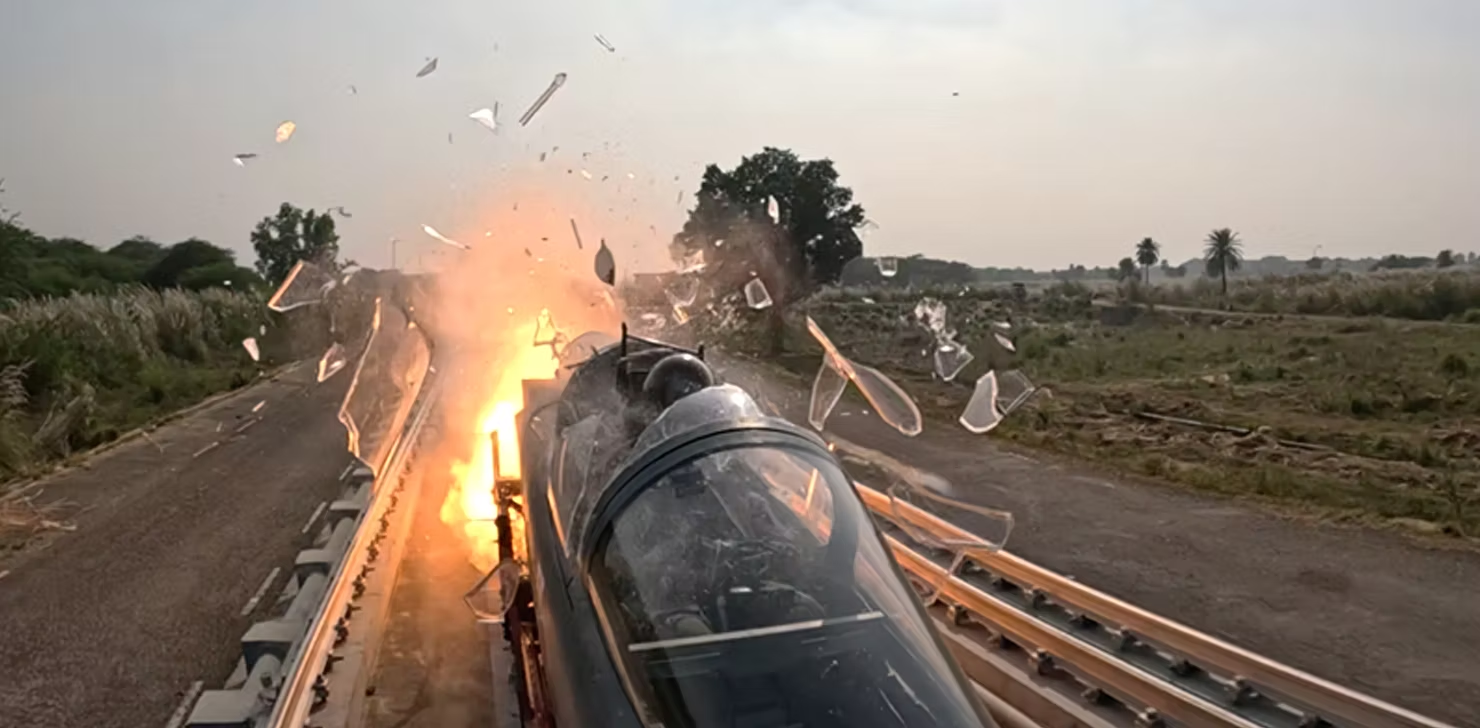
The Defence Research and Development Organisation (DRDO) has achieved a major breakthrough by successfully conducting a high-speed rocket-sled test of an advanced fighter aircraft escape system at a precisely controlled velocity.
The test, carried out at the Rail Track Rocket Sled (RTRS) facility of the Terminal Ballistics Research Laboratory (TBRL) in Chandigarh, marks a crucial step in validating the performance of canopy severance, accurate ejection sequencing, and complete aircrew recovery mechanisms. These capabilities are essential to ensuring a pilot’s safe escape during emergency situations in high-performance fighter aircraft.
The achievement was made possible through close collaboration between DRDO, the Aeronautical Development Agency (ADA), and Hindustan Aeronautics Limited (HAL). Their joint effort in executing this complex dynamic test places India among a select group of nations possessing sophisticated, in-house escape-system testing infrastructure. Such capability reflects the country’s growing technological maturity in aviation safety and indigenous defence development.
Dynamic ejection tests of this nature are considered far more challenging than static tests like the Net test or Zero-Zero test. Unlike static evaluations, dynamic tests simulate real-world emergency escape scenarios and are the most reliable means to assess ejection seat efficiency and the effectiveness of canopy separation systems.
READ ALSO: https://www.modernmechanics24.com/post/neurips-nvidia-digital-physical-ai
For this demonstration, a specially designed dual-sled system integrated with the forebody of the Light Combat Aircraft (LCA) was accelerated to a precisely monitored high speed through sequential firing of multiple solid-propellant rocket motors.
To replicate the actual conditions a pilot would face, engineers used an instrumented Anthropomorphic Test Dummy (ATD). The dummy was equipped to gather critical data on loads, forces, moments, and accelerations experienced during the ejection process.
This allowed the team to evaluate the structural stresses and biomechanical effects with high accuracy. The entire escape sequence was captured using a combination of onboard sensors and ground-based high-speed imaging systems, ensuring a comprehensive analysis of every stage of the test. Officials from the Indian Air Force (IAF) and the Institute of Aerospace Medicine were present to witness the event.
WATCH ALSO:https://www.modernmechanics24.com/post/isro-gaganyaan-crew-parachute-validation
Raksha Mantri Shri Rajnath Singh congratulated DRDO, IAF, ADA, HAL, and the Indian defence industry for the landmark accomplishment. He described it as a significant stride toward enhancing India’s self-reliance in defence technologies. DRDO Chairman and Secretary, Defence R&D, Dr. Samir V. Kamat also praised the team for their dedication and the successful completion of this vital demonstration.