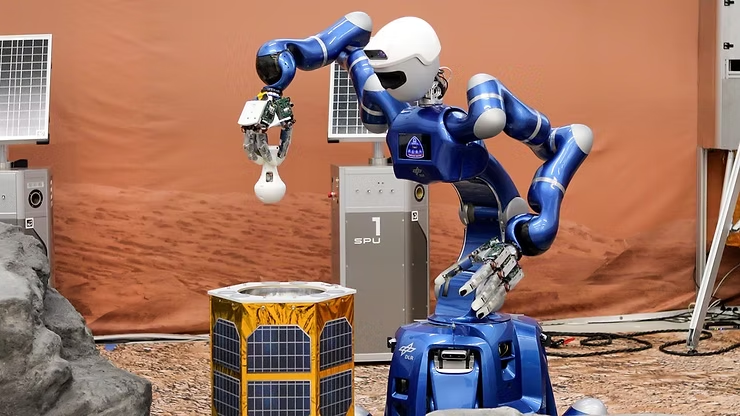
On 24 July 2025, the German Aerospace Center’s (DLR) ‘Earthly Mars’ test site in Oberpfaffenhofen became the stage for a groundbreaking experiment. Four advanced robots and a live connection to the International Space Station (ISS) came together for the final and most demanding test in the Surface Avatar project. From aboard the ISS, NASA astronaut Jonny Kim remotely controlled the robotic team on the ground as they navigated the simulated Martian terrain and collected geological samples. Depending on the task, he could operate the robots together, in semi-autonomous mode, or let them function fully autonomously. A new addition to the experiment was ‘Neal AI’ — an intelligent chatbot assistant that provided real-time support, answering the astronaut’s queries during the mission.
“Surface Avatar marks a major milestone in human-robot interaction in space. We’ve now met all the technical criteria for running complex robotic operations on Mars and for supporting a future lunar research base,” said Alin Albu-Schäffer, Director of DLR’s Institute of Robotics and Mechatronics.
The project’s goal is to allow astronauts with minimal training to effectively control a diverse team of robots. Launched in 2022, Surface Avatar is led by the DLR Institute of Robotics and Mechatronics, in partnership with the European Space Agency (ESA) and the German Space Operations Center (GSOC).
“Incorporating an astronaut in microgravity and leveraging relay satellites has allowed us to overcome key technical challenges in remotely operating robots,” explains Thomas Krüger, head of ESA’s Human-Robot Interaction Lab. “This gives us confidence in handling future missions — whether it’s operating from the Lunar Gateway, working within Moon habitats, or managing robotic systems from Earth. These experiments have helped us build a distinct body of expertise in Europe, with potential benefits for terrestrial applications as well.”
More Robots, Greater Challenges
Since the previous campaign in July 2024, both the complexity of tasks and the level of robot autonomy have significantly increased. A fourth robot has also joined the lineup. Alongside DLR’s humanoid robot Rollin’ Justin, ESA’s Interact rover, and DLR’s four-legged robot Bert, the ESA quadruped robot ‘Spot’ is now part of the exploration team.
READ ALSO: Boeing Lands $2.8B Deal to Boost U.S. Strategic Satellite Communications
READ ALSO: US’ defence giant hits big milestone, delivers crucial F-35 fighter jet part every 30 hours
Larger than Bert and equipped with a robotic arm, Spot was directed by astronaut Jonny Kim to autonomously search for scattered sample containers and deliver them to a designated transfer station. From there, DLR’s Rollin’ Justin took over, transporting the containers to the simulated lander. Working together autonomously, the two robots successfully retrieved several ‘Martian samples’ for return, enabling the astronaut to focus on upcoming mission tasks.
Four-Legged Robot Learns to Limp
In one of the mission’s most impressive demonstrations of robotic teamwork and adaptability, the Surface Avatar team tackled a simulated cave exploration challenge. Astronaut Jonny Kim remotely operated the Interact rover, which was transporting DLR’s quadruped robot Bert in its onboard basket—marking the first-ever instance of one robot carrying another. Under Jonny’s control from space, the Interact rover navigated to the cave, gently lifted Bert using its robotic arm, and placed it on the ground.
However, Bert faced an unexpected obstacle: one of its legs was intentionally jammed, making normal movement impossible. This deliberate malfunction, introduced by the team on Earth, was designed to simulate an unforeseen issue in a real mission scenario. Bert is equipped with reinforcement learning, a type of AI that allows it to adapt through trial and error. To help Bert adjust to its new condition, Jonny guided the robot through a series of training exercises, testing different gaits and selecting the most effective one for moving with just three legs. After successfully adapting its movement, Bert resumed the cave exploration.
For this task, Jonny chose to control Bert manually. Using the robot’s camera feed and a joystick interface, he navigated the terrain from space, essentially seeing and acting through the robot’s eyes.
READ ALSO: New Partnership to Lead Innovation in Space Solar Technology
READ ALSO: The world’s largest solar-powered vehicle carrier successfully completes its first voyage
AI-Assisted Mission Prep
The collaboration between NASA astronaut Jonny Kim aboard the International Space Station and the robotic team in the simulated Mars habitat in Oberpfaffenhofen ran so smoothly that even the optional tasks were completed within the tight two-and-a-half-hour window. Kim manually piloted a rover to retrieve a sample container and place it at the transfer station. He used the robots to move around the terrain, observe the environment, and physically interact with it. The robots acted as intelligent teammates on the ground—capable of planning and executing mission objectives—essentially serving as his remote avatars.
Ahead of the mission, Kim trained with a new AI assistant called ‘Neal AI’, based on a large language model developed by European provider Mistral AI. Custom-trained by the DLR Institute of Robotics and Mechatronics, Neal AI was fine-tuned specifically for the Surface Avatar mission. During preparation, it helped Kim understand robot capabilities, control procedures, and how to use the interface effectively.
On future Mars missions, where communication with Earth can be delayed by up to 40 minutes, an AI assistant like Neal AI could be vital—providing real-time support to astronauts when ground control isn’t immediately available.
Pioneering Robotics from Germany and Europe
“The final Surface Avatar experiment was a perfect wrap-up to the mission,” said Neal Y. Lii, Principal Investigator from DLR’s Institute of Robotics and Mechatronics. “It clearly showed how robotics can assist astronauts in space exploration. I’m excited to build on this success and continue working closely with ESA on future projects.”
The Surface Avatar series concluded with a symbolic gesture: a handshake between NASA astronaut Jonny Kim and DLR scientist Neal Lii—facilitated by DLR’s humanoid robot Rollin’ Justin. Using force feedback technology, the robot transmitted the physical sensation of the handshake to both participants, bridging the distance between space and Earth. It was a powerful moment, showcasing Germany’s cutting-edge robotics and its global leadership in developing control systems that compensate for communication delays in space.
This remote handshake was a fitting finale to the collaboration between DLR and ESA. As artificial intelligence continues to advance, robotics will play an increasingly vital role in expanding human presence beyond Earth.