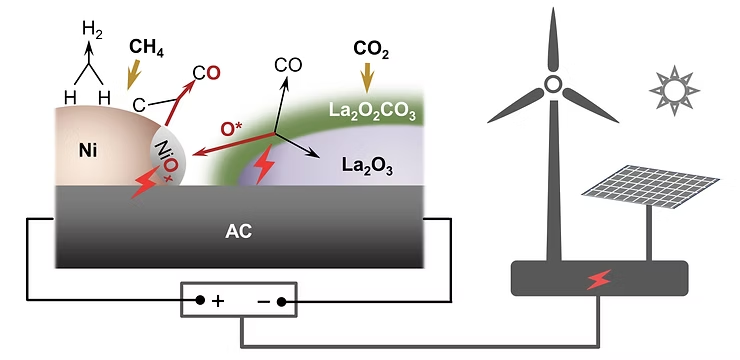
In a groundbreaking development, a team of scientists from the Ningbo Institute of Materials Technology and Engineering (NIMTE) has unveiled an innovative electrified catalysis strategy that not only reduces greenhouse gas emissions but actually removes more than it generates. This remarkable achievement marks a significant step towards combating climate change and achieving net-negative emissions.
China method can deal with challenge of greenhouse gases
Carbon dioxide (CO2) and methane (CH4) are the primary culprits behind human-induced global warming, contributing to a staggering 95% of the problem. As the world grapples with the urgent need to mitigate climate change, finding effective methods to remove these gases from the atmosphere has become a top scientific priority.
One promising approach involves converting CO2 and CH4 into syngas—a vital feedstock for producing high-value chemicals—through a process known as dry reforming of methane (DRM). However, traditional DRM methods operate at extremely high temperatures, often exceeding 800°C, and are typically powered by fossil fuels. This creates a paradox: the CO2 emissions from combustion often surpass the amount converted, undermining efforts to reduce overall emissions.
A revolutionary solution: Electrified DRM
Now, thanks to the efforts of Prof. Zhang Jian and Prof. Zhang Yexin from NIMTE, along with Prof. Zhang Zhaoliang from the University of Jinan, a new method called electrified DRM (e-DRM) has emerged. This innovative strategy utilizes renewable electricity from sources such as wind, solar, hydropower, and nuclear energy to convert CO2 and CH4 into syngas with an impressive energy utilization rate of 80%.
In a study published in Science Advances, the researchers demonstrated that the e-DRM process not only achieves thermodynamic equilibrium conversion but also maintains stability for over 120 hours. Prof. Zhang Yexin highlighted the remarkable energy efficiency of 2.976 mmol/kJ, showcasing the potential of this new approach.
Mechanisms behind the breakthrough
The success of e-DRM lies in its ability to facilitate electrically driven lattice oxygen transfer, which accelerates redox cycles between CO2 and CH4. This universal effect has been observed in other electrified reactions, such as soot oxidation and NOx reduction, indicating a broader application for electrified catalysis.
Transformative impacts
This breakthrough not only advances the transition of DRM from laboratory research to commercial application but also holds the promise of transformative benefits across environmental, social, and governance dimensions. By effectively converting more CO2 than is emitted during electricity generation, this innovative approach could play a crucial role in the global fight against climate change.
The research was supported by various organizations, including the National Natural Science Foundation of China, the Taishan Scholar Program of Shandong, and the Ningbo Municipal Natural Science Foundation, among others. As the world continues to seek sustainable solutions, the work of these dedicated scientists shines a hopeful light on the path to a greener future.