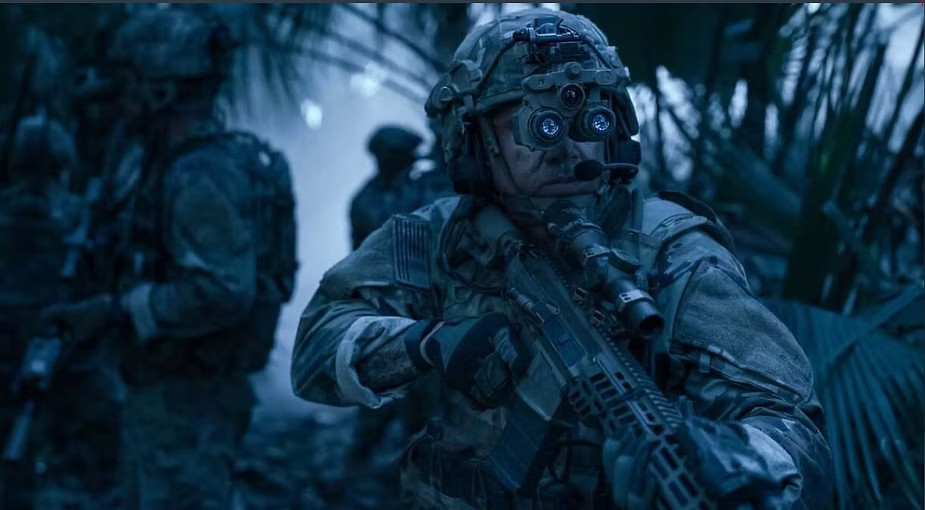
L3Harris Technologies has taken a major step in strengthening the U.S. Army’s next-generation soldier systems by integrating its Enhanced Night Vision Goggle – Binocular (ENVG-B) with Anduril Industries’ Soldier Borne Mission Command (SBMC) solution. This collaboration combines L3Harris’ battle-proven night-vision technology with Anduril’s advanced Lattice-enabled mission command architecture, creating a unified platform designed to deliver unprecedented situational awareness, resilience, and connectivity on the battlefield.
The U.S. Army has already procured more than 35,000 ENVG-B systems, underscoring the technology’s reliability and value to frontline forces. With this new integration, the ENVG-B system becomes a crucial node within Anduril’s SBMC Architecture (SBMC-A), boosting the Army’s command-and-control capabilities while enhancing communications and tactical-edge awareness.
A Leap Forward in Soldier-Centric Technology
“L3Harris’ superior ENVG-B capability, enhanced by Lattice, forms a next-generation headborne system that greatly increases soldiers’ awareness and enables resilient, connected warfare,” said Sam Mehta, President of Communication Systems at L3Harris. “Bridging today’s battle-proven technology with revolutionary vision-augmentation solutions will enable U.S. troops to operate faster and more effectively than ever before across any battlefield.”
The ENVG-B program has been a cornerstone of L3Harris’ contributions to the Army, providing fused night-vision capability that blends infrared imaging and night-vision technology into a single device. By delivering clearer, more accurate visuals in low-light or no-light conditions, ENVG-B ensures soldiers retain a critical edge during nighttime operations or in environments where visibility is compromised.
Interoperability and Open-Architecture Design
One of the defining strengths of the ENVG-B is its interoperable, open-system design. This architecture allows seamless two-way connections between soldiers and other nodes within the battlespace. Whether linked to unmanned systems, command posts, or broader command-and-control assets, the ENVG-B is designed to act as both a sensor and a data-sharing platform.
This integration with SBMC-A takes advantage of that interoperability. By leveraging Anduril’s Lattice artificial intelligence and autonomy framework, the combined system enhances situational awareness, shortens decision-making cycles, and improves coordination between dismounted soldiers and higher-level command structures. In fast-moving operational scenarios, such real-time data flow can be decisive, enabling soldiers to adapt instantly to shifting conditions.
READ ALSO: https://www.modernmechanics24.com/post/columbia-class-submarine-wisconsin-keel
Expanding Collaboration for Future Capabilities
The partnership between L3Harris and Anduril is not limited to the ENVG-B program. Both companies have signaled plans to broaden their collaboration, exploring opportunities in next-generation long-range, low-light sensor technologies and advanced tactical networking capabilities. These efforts are intended to further refine and expand the SBMC system, ensuring it evolves in step with the Army’s modernization priorities.
By integrating ENVG-B with emerging technologies, future iterations of the SBMC platform may extend soldiers’ operational reach, provide more resilient networks in contested environments, and introduce greater automation into mission command workflows. Both firms are also considering joint efforts in adjacent programs and technology domains, underscoring a commitment to long-term collaboration.
READ ALSO: https://www.modernmechanics24.com/post/rare-superconductor-reveals-quantum-secrets
Supporting the Army’s Modernization Goals
The U.S. Army’s modernization strategy places strong emphasis on connected, soldier-centric systems that integrate seamlessly across domains. As warfare grows increasingly data-driven, the need for devices that can fuse sensing, networking, and command-and-control functions is more critical than ever. The ENVG-B and SBMC integration represents a practical step toward realizing that vision.
By enabling resilient communication, augmented vision, and synchronized command-and-control, the combined solution addresses a key requirement: giving dismounted soldiers not only superior visibility but also access to the same quality of information that higher-level commanders use to guide operations. This democratization of battlefield data can be transformative in maintaining overmatch against near-peer adversaries.