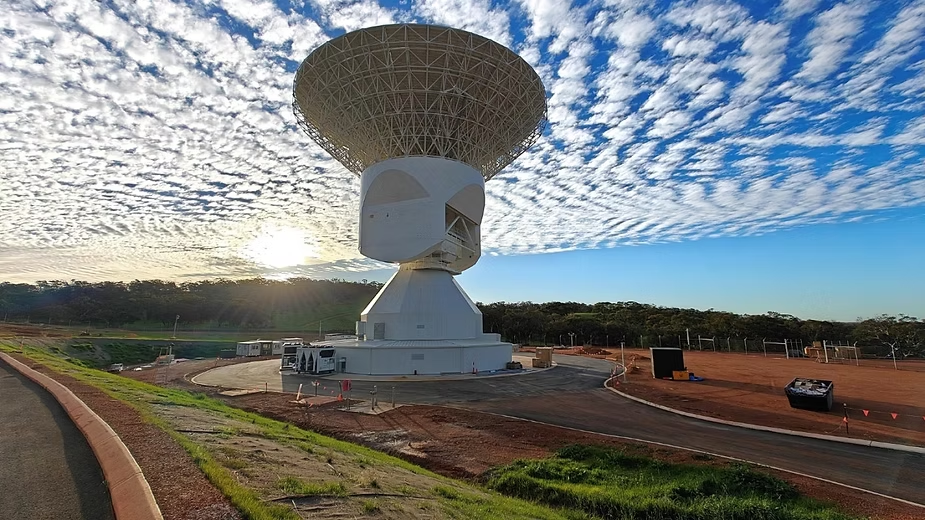
The European Deep Space Antenna Alliance (E-DSA²) — comprising Thales Alenia Space, Schwartz Hautmont, and mtex antenna technology — has marked a major milestone in Europe’s space exploration capabilities with the inauguration of the European Space Agency’s (ESA) NNO-3 deep space antenna. The ceremony, held on October 4 near Perth, Australia, celebrated the completion of this technological masterpiece at ESA’s New Norcia ground station, part of the agency’s global ESTRACK network.
The new 35-meter-diameter NNO-3 antenna represents a significant leap forward in deep space communications. Designed to operate across the X, K, and Ka frequency bands, it will enable ESA to strengthen its network for tracking, commanding, and collecting data from spacecraft journeying across the solar system.
Expanding ESA’s Deep Space Communication Network
With NNO-3 now operational, ESA enhances its capacity to support both current and future scientific missions exploring the mysteries of the universe. The antenna will play a crucial role in communicating with spacecraft such as the ExoMars Trace Gas Orbiter, which continues its study of the Martian atmosphere, and Euclid, a mission dedicated to mapping one-third of the sky to uncover the secrets of dark matter and dark energy.
In a promising demonstration of its capabilities, NNO-3 has already received its first signal from the Euclid spacecraft, confirming the antenna’s readiness for deep space communication. The system’s primary challenge lies in detecting and amplifying extremely faint signals transmitted over millions of kilometers — a task that requires extraordinary precision and engineering excellence. By converting these weak signals into robust data streams, NNO-3 enables scientists to receive invaluable information from distant missions while maintaining reliable uplinks for command transmission.
READ ALSO: https://www.modernmechanics24.com/post/britten-norman-restores-full-uk-islander-production
The antenna will also support upcoming missions such as Plato, scheduled for launch next year. Plato aims to detect and study exoplanets, helping scientists understand planetary systems beyond our own.
A Collaborative Engineering Achievement
The success of NNO-3 stands as a testament to the collective expertise of the E-DSA² partners. Thales Alenia Space, a joint venture between Thales (67%) and Leonardo (33%), served as the prime consortium partner responsible for the overall performance and systems engineering of the antenna. The company managed the integration of key systems — including radio frequency, power distribution, and cooling subsystems — ensuring the antenna’s seamless functionality in the demanding conditions of deep space operations.
Schwartz Hautmont, renowned for its engineering and fabrication excellence, was responsible for the mechanical structure design, manufacturing, and on-site installation of the massive 35-meter dish. Meanwhile, mtex antenna technology handled the mechanical design, procurement, installation, and testing, ensuring precise alignment and structural stability to guarantee optimal performance.
WATCH ALSO: https://www.modernmechanics24.com/post/spacex-sends-science-cargo-to-space-station
“This project began as a challenge to push the limits of existing deep space antenna technology,” said Antonio Aldecoa, CEO of Schwartz Hautmont. “Through close collaboration, each E-DSA² partner contributed its unique strengths, resulting in a state-of-the-art antenna that will serve Europe’s most ambitious space missions. We are proud to have earned ESA’s trust and to deliver this remarkable achievement.”
European Industrial Collaboration at Its Best
The E-DSA² consortium exemplifies Europe’s collaborative approach to high-technology innovation. Alongside its three founding members, the consortium draws on the specialized expertise of additional European firms. Callisto France, based in Villefranche-de-Lauragais, supplied the cryogenically cooled low-noise amplifiers (LNAs) — vital components that enable the antenna to detect the faintest of signals from deep space. Rheinmetall Italy provided the high-power amplifiers (HPAs), crucial for boosting the transmission of data to spacecraft billions of kilometers away.
Together, these contributions have produced one of the most advanced deep space communication systems ever built in Europe. The NNO-3 antenna not only enhances ESA’s operational capabilities but also symbolizes Europe’s growing independence and leadership in space infrastructure.
With its cutting-edge technology and European-built design, NNO-3 will play a key role in enabling ESA to communicate with and control missions venturing to distant planets and beyond, reinforcing Europe’s commitment to exploring the final frontier.