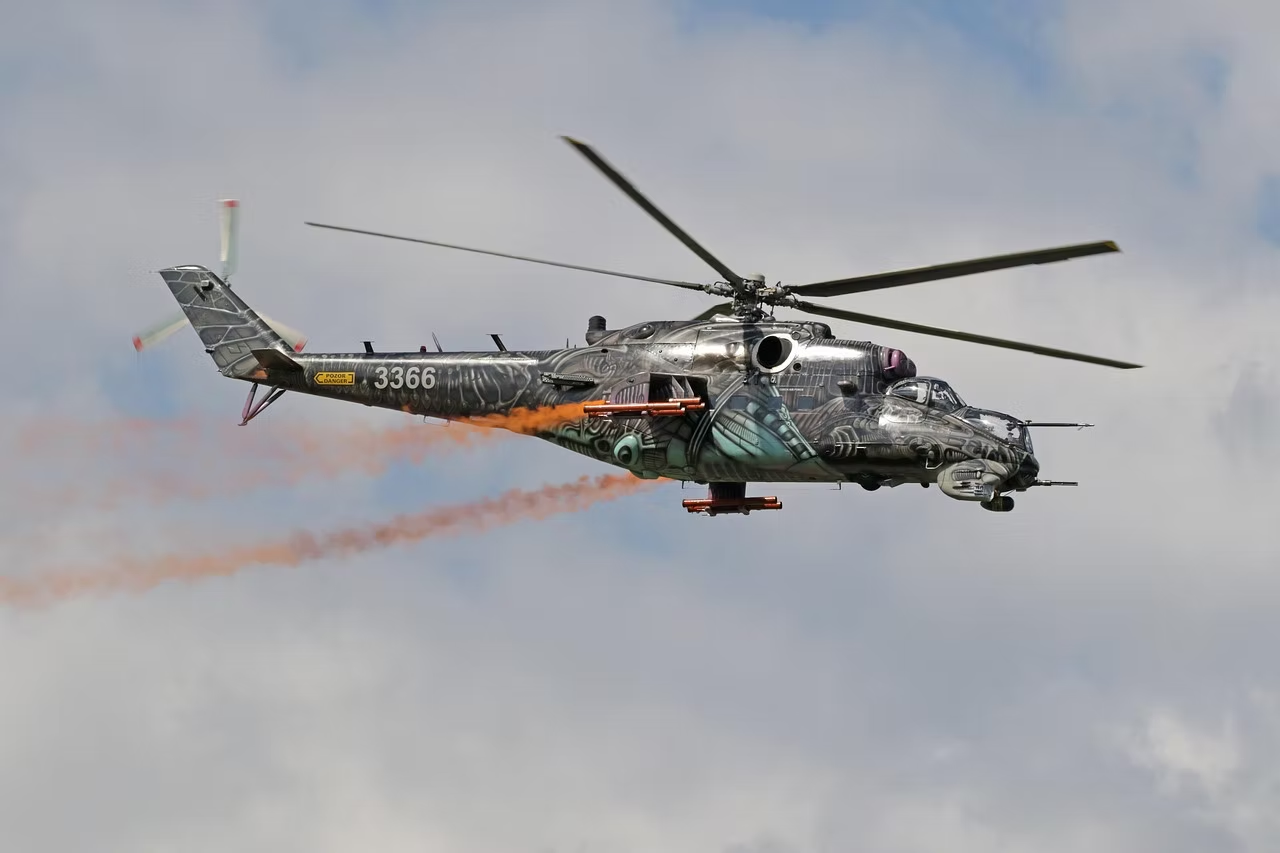
China’s Moyujian unmanned reconnaissance and strike helicopter completed live-fire target tests in July at altitudes exceeding 4,000 meters while carrying two missiles, marking readiness for critical combat testing. Developed by Sichuan Tengden Technology, the helicopter was displayed at Asia General Aviation Exhibition (Aero Asia) from November 27-30 in Zhuhai, with next-phase testing planned at over 6,000 meters using satellite communication and beyond visual line of sight control, featuring a maximum range of 1,000 kilometers, flight time of 9 hours, and service ceiling of 7,200 meters.
China’s unmanned reconnaissance and strike helicopter tailored for deployment in plateau areas is ready for critical combat testing. The new multipurpose medium-sized helicopter was displayed on November 27 at an air show in Zhuhai, in southern China, where the next stage of testing was announced by its developer.
The Moyujian was exhibited at the second Asia General Aviation Exhibition (Aero Asia), held from November 27 to 30. Aero Asia, jointly organized by the German General Aviation Exhibition and Airshow China, was held for the first time in 2023. The event, which takes place every two years, is China’s only general aviation exhibition held with a foreign partner, and the most recent edition featured 174 Chinese and foreign aircraft.
The unmanned helicopter was shown in its camouflage livery on a static display. The display also featured a video of the aircraft’s first successful live-fire target test at high altitude, which its developers said marked progress in its reliability for plateau operations.
READ ALSO: https://www.modernmechanics24.com/post/tibet-dung-microbes-transform-biotech
Developed by the Chinese private company Sichuan Tengden Technology, the helicopter made its maiden flight in 2019. The company said the uncrewed vehicle had excellent deployment capabilities on plateaus and at sea, and could be applied to reconnaissance and strike operations, emergency rescue, communications relay and forest fire prevention.
An unmanned helicopter operator from Tengden told state broadcaster CCTV that the Moyujian completed live-fire target tests in July at an altitude exceeding 4,000 meters (13,100 feet) while carrying two missiles to conduct strike tests on both moving and stationary targets. “The next phase of testing will be a target test mission using satellite communication and beyond visual line of sight control, at an altitude of over 6,000 meters,” the operator added.
According to Tengden’s official website, the Moyujian has a maximum range and flight time of 1,000 kilometers (621 miles) and 9 hours, respectively. It says the aircraft features a high-altitude take-off and landing capability with a service ceiling of 7,200 meters, specifically tailored for extremely harsh environments.
WATCH ALSO: https://www.modernmechanics24.com/post/china-humanoid-robot-combat-moves
In the six years since its maiden flight, the Moyujian has completed six years of tests in complex high-altitude terrain, payload and mission systems, marine flight applications and forest fire prevention, and has entered the combat testing phase, according to the company. The aircraft’s name comes from Zhang Qing, a character in the ancient Chinese novel Water Margin nicknamed Moyujian, or “featherless arrow,” who could kill enemies by throwing stones.
Its action and attack capability at high altitudes and in harsh weather is crucial for operations on China’s highest plateau, the Tibetan Plateau. The area includes the rugged Himalayan border with India, where the altitude typically ranges from 4,000 to 5,000 meters. Its range and wind resistance also make the helicopter suitable for maritime operations, including wide-area patrols over the ocean, such as in the South China Sea.
The strategic implications of high-altitude unmanned strike capabilities prove significant for China’s border security and regional operations. The Tibetan Plateau, often called the “roof of the world,” presents extreme operational challenges where conventional aircraft struggle with reduced engine performance and lift in thin air. The Moyujian’s 7,200-meter service ceiling exceeds most operational requirements in the region.
READ ALSO: https://www.modernmechanics24.com/post/china-hualong-one-record-nuclear-startup
The helicopter’s dual-environment capability—both plateau and maritime—reflects China’s strategic priorities. The Himalayan border with India has seen periodic tensions, including the 2020 Galwan Valley clash. Meanwhile, disputes in the South China Sea involve multiple nations claiming overlapping territories, making long-range surveillance and strike capabilities valuable for China’s maritime territorial assertions.
The 1,000-kilometer range and 9-hour endurance enable extended operations far from base locations. Unlike crewed helicopters requiring pilot rotation and life support systems, unmanned platforms can maintain prolonged surveillance or loiter in position awaiting strike opportunities without human fatigue factors.
Beijing has doubled down on developing unmanned equipment, joining the global race to create drones that can be used for civilian and military purposes. The drive has resulted in landmark achievements for some all-terrain and all-weather equipment.
China showcased new uncrewed equipment at its Victory Day parade on September 3, including submarines, loyal wingmen, drone combat vehicles and robot dogs.
Its Chinook-style heavy-lift unmanned helicopter Boying T1400, which is capable of operating in extreme conditions from the Himalayas to the South China Sea, completed its maiden flight last month.
WATCH ALSO: https://www.modernmechanics24.com/post/swiss-robot-brain-autonomy
Beijing also deployed drones to a military airport in the Shigatse region of Tibet in August and September, according to satellite images. And in October, it set up a high plateau test center for unmanned equipment in Ali, a prefecture in Tibet also known as Ngari, according to state news agency Xinhua.
The Xinjiang Military Command in January conducted a logistics support exercise at an altitude of 5,300 meters on a plateau in the Karakoram Range, featuring robot dogs and unmanned combat vehicles, another Xinhua report said.
The Sichuan Tengden Technology development represents China’s growing private defense sector participation. Historically dominated by state-owned enterprises, Chinese military procurement increasingly incorporates private company innovations, particularly in emerging technologies like unmanned systems where startups can move faster than traditional defense contractors.
The planned 6,000-meter testing altitude represents significant technical achievement. At such elevations, air density drops to roughly half that at sea level, dramatically reducing rotor efficiency and engine power. Successfully operating weapon systems in these conditions requires specialized engineering for fuel systems, avionics cooling, and flight control algorithms.
READ ALSO: https://www.modernmechanics24.com/post/2nd-bomb-wing-calibration-lab-upgrade
The satellite communication and beyond visual line of sight control testing addresses critical operational requirements. Direct radio control limits unmanned aircraft to relatively short ranges where operators can maintain line of sight. Satellite links enable control from anywhere on Earth, though they introduce communication latency and potential vulnerability to jamming or interception.