Credit: Spacex
A cluster of British-designed and built satellites has been successfully deployed into low Earth orbit, enhancing the UK’s capabilities in space-based intelligence, surveillance, and reconnaissance (ISR) across defence, security, and civil sectors. The mission represents a major step forward in supporting national resilience against evolving global threats.
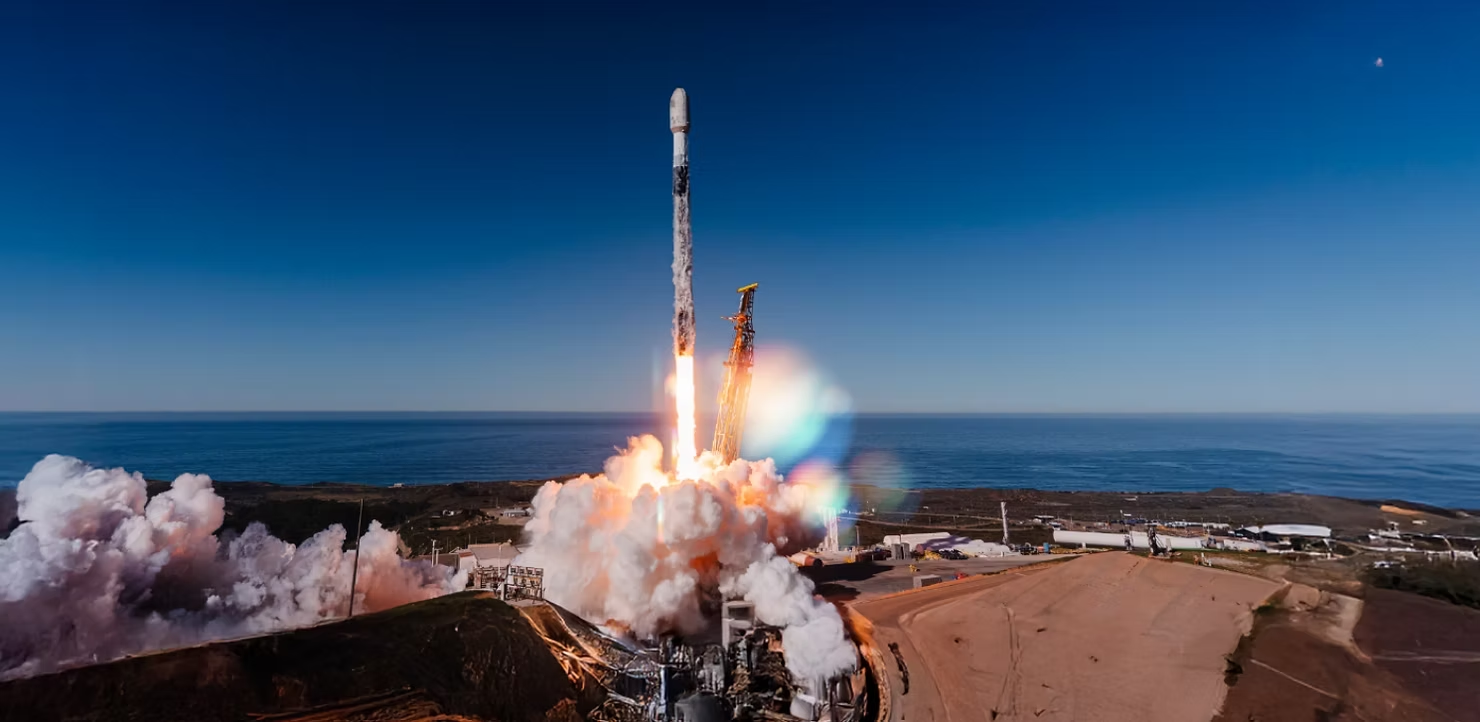
On 28 November 2025, three Azalea radio frequency (RF) satellites, designed and built by BAE Systems, were launched via Exolaunch aboard SpaceX’s Transporter-15 rideshare mission. Communications with the UK satellites were successfully established during the first three contact windows, between 23:05 and 04:55 GMT, confirming the spacecraft were functioning as intended.
This milestone is part of BAE Systems’ self-funded Azalea mission, which will see the three satellites flying in formation at an altitude of 350 miles. Equipped with ultra-wideband RF sensors, the spacecraft can monitor and geolocate radio signals over vast distances, delivering actionable intelligence from space.
Joining the RF satellites is a Synthetic Aperture Radar (SAR) satellite from Finnish company ICEYE, also launched on Transporter-15. The SAR satellite can see through cloud cover to generate detailed images of the Earth’s surface, creating a four-satellite cluster capable of multi-sensor fusion in orbit.
The cluster is designed to process RF and SAR data in space, providing near real-time intelligence to decision-makers across land, sea, and air. This capability will support armed forces, protect critical infrastructure, and detect illegal activities at sea. Over the coming months, BAE Systems will test the integrated RF and SAR system in collaboration with customers, exploring use cases ranging from intelligence gathering to disaster response.
Andrea Thompson, Group Managing Director of BAE Systems’ Digital Intelligence business, said: “The Azalea mission demonstrates the critical role of space in national security. By providing a unique vantage point, these satellites allow us to better understand and respond to complex threats in real time. This cutting-edge technology empowers users to make informed decisions that protect the UK and our allies.”
Each RF satellite weighs approximately 150 kilograms and carries the Azalea Enhanced Software Defined Radio, developed entirely by BAE Systems. The onboard system leverages artificial intelligence (AI) to process RF and SAR data, transform it into actionable intelligence, and securely transmit it back to Earth.
WATCH ALSO: https://www.modernmechanics24.com/post/apache-drone-killer-operation-flyswatter
The payload is remotely reconfigurable in orbit, ensuring Azalea remains at the forefront of space technology and capable of supporting future missions. The satellites will orbit the Earth at approximately 7.6 kilometres per second, completing a full orbit every 90 minutes.
Dr. Paul Bate, CEO of the UK Space Agency, commented: “The successful launch of the Azalea constellation will increase access to advanced space-based intelligence for defence, security, and civil users. By converting raw data into actionable intelligence using AI, these satellites represent a major investment by BAE Systems in the UK space sector, which is crucial for economic growth and national security.”
About BAE Systems Digital Intelligence
Digital Intelligence employs over 4,500 experts across 13 countries, operating at the forefront of digital, cyber, and intelligence innovation. The division supports critical national infrastructure, armed forces, and national security efforts, delivering advanced solutions for defence and civil applications.
READ ALSO: https://www.modernmechanics24.com/post/surrey-circular-roadmap-space-waste
As part of BAE Systems, Digital Intelligence draws on decades of experience in space technologies, including telemetry, antennas, waveforms, electronics, and signal processing. The company has the capability to design, build, and operate complete satellite systems, providing complex solutions for operations in near-Earth and deep-space environments.
BAE Systems continues to partner with governments, communities, and companies worldwide to deliver innovative defence and security technologies that protect both national interests and global partners.