Researchers at the University of California San Diego (UCSD) have made an important discovery about diamond, the material used to contain fuel for some of the world’s most advanced fusion energy experiments. Their work sheds light on how structural flaws in diamond can emerge under extreme conditions and potentially undermine the performance of nuclear fusion reactions at the National Ignition Facility (NIF), housed at the U.S. Department of Energy’s Lawrence Livermore National Laboratory.
Diamonds Under Pressure
At NIF, scientists attempt to recreate the conditions found at the core of stars by using the world’s most powerful laser system. Thousands of laser beams converge on a tiny diamond capsule filled with two hydrogen isotopes: deuterium and tritium. The aim is to compress the fuel to temperatures and pressures high enough to force atomic nuclei to fuse, releasing vast amounts of energy in the process.
For the experiment to succeed, the implosion of the capsule must be perfectly symmetrical. Even small irregularities can reduce the efficiency of the reaction, causing energy losses and preventing the system from reaching ignition, the point where the fusion reaction becomes self-sustaining.
Diamonds are chosen for their strength, density, and ability to withstand the tremendous forces involved. But the new UCSD study shows that even this remarkable material has its limits.
READ ALSO: Bio-Hybrid Drone Uses Silkworm Moth Antennae to Navigate Using Smell
READ ALSO: Robotic “Dogs” Train for Mars in New Mexico’s Desert
Discovering the Flaws
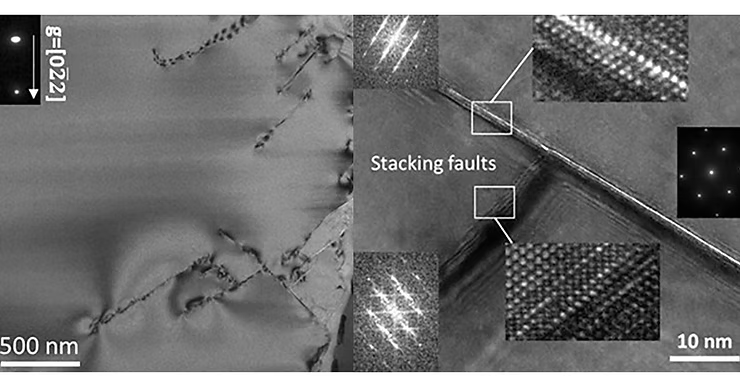
To investigate, the research team used a high-power pulsed laser to mimic the extreme pressures that diamond capsules experience during NIF’s fusion experiments. What they observed was striking: under these conditions, the crystal structure of diamond can develop a variety of microscopic defects.
These ranged from subtle distortions in the arrangement of carbon atoms to narrow regions where the material lost its crystalline order entirely, a process known as amorphization. In these zones, diamond transforms from an orderly lattice into a disordered structure more like glass.
Such flaws may seem small, but at the scale of a fusion capsule, they matter. Even tiny disruptions can cause uneven compression during implosion. That asymmetry reduces the efficiency of the reaction, lowering the energy yield and in some cases preventing ignition altogether.
READ ALSO: Mercedes-Benz expands its modular and scalable Van Architecture
READ ALSO: Northern Lights’ first CO2 transport ship ready for delivery
Implications for Fusion Research
Fusion researchers have long known that capsule symmetry is critical, but this study provides direct evidence of how diamond itself can fail under the necessary conditions. By identifying how and where defects form, the findings give scientists new tools for designing stronger and more reliable capsules.
“Uniform implosions are absolutely essential for maximizing energy output,” the UCSD researchers noted. “Any distortion can throw off the balance, and our results highlight one of the ways this can happen.”
This knowledge will be valuable not only for improving capsule materials but also for refining the models and simulations that guide fusion research. If scientists can account for diamond’s vulnerabilities in their designs, they can work to prevent or minimize the effects of structural defects before experiments take place.
A Step Toward Practical Fusion Energy
The discovery comes at a time when nuclear fusion is closer than ever to proving its potential as a virtually limitless source of clean energy. In recent years, NIF has achieved major milestones, including demonstrating net energy gain in a controlled fusion experiment. Each incremental advance — whether in capsule design, laser technology, or theoretical modeling — brings the goal of practical fusion power closer to reality.
Fusion energy promises to generate massive amounts of electricity with no carbon emissions, no long-lived radioactive waste, and an abundant fuel supply derived from hydrogen. However, making it practical requires solving a series of difficult scientific and engineering challenges.
The UCSD team’s findings represent progress on one of those fronts: understanding the limitations of the materials that make fusion possible.
Looking Forward
By uncovering how diamond responds under extreme conditions, researchers can now begin to explore alternative materials or methods to reinforce capsule performance. They may also look into ways of engineering diamonds with fewer vulnerabilities, such as controlling their microstructure during growth or applying protective coatings.
The study also underscores the importance of combining experimental work with advanced simulations. Computer models can now be updated to incorporate the effects of amorphization and other defects, allowing scientists to test new capsule designs virtually before building them.
Ultimately, each piece of knowledge brings fusion energy a step closer to reality. While challenges remain, the ability to diagnose and address weak points in critical components like fuel capsules represents a meaningful advance in the quest for clean, sustainable power.
Conclusion.
Diamonds may be among the hardest materials on Earth, but under the extraordinary conditions of a fusion experiment, they can still falter. The UCSD study reveals the hidden weaknesses in diamond fusion capsules, offering a roadmap to stronger, more effective designs.
By understanding how defects form and disrupt implosions, scientists are better positioned to optimize fusion experiments and inch closer to making star power on Earth a practical energy source.