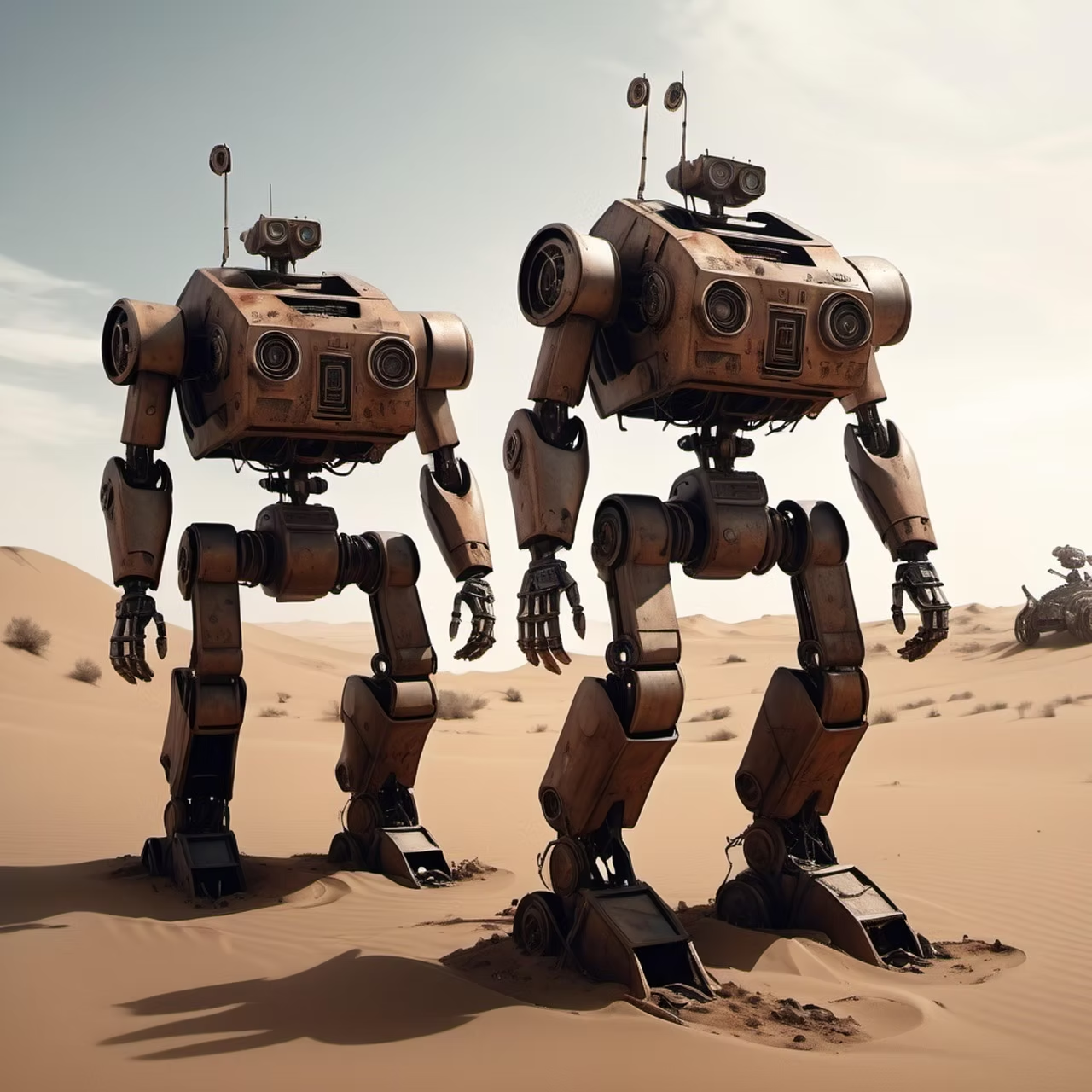
China’s People’s Liberation Army showcased a “Real Steel-style” military robot that precisely mimicked a soldier’s combat moves in real-time to defense representatives from 13 countries during the 12th International Army Cadets Week held November 3-9 at the Army Engineering University in Nanjing, Jiangsu province.
The motion-controlled robot uses artificial intelligence and a lightweight motion-sensing device to capture attack maneuvers, according to Science and Technology Daily on November 28, with cadets from Morocco, Pakistan, Thailand, Egypt, Brazil, and Serbia also testing AI-powered mine-clearing robots and voice-controlled bomb disposal robots while discussing ethical boundaries of AI in warfare.
China’s People’s Liberation Army has shown off a “Real Steel-style” military robot that mimicked a soldier’s combat moves in real time to defense representatives from 13 countries. Capturing every attack maneuver of a person wearing a lightweight motion-sensing device, the motion-controlled robot could precisely match moves with the help of artificial intelligence, according to a report in the official Science and Technology Daily on November 28.
In the 2011 American movie Real Steel, a former prizefighting boxer returns to his sport which has been taken over by human-directed robots using a “shadow function”—or real-time motion control. The “steel clone” combat robot is the latest in China’s drive to develop autonomous combat systems for modern warfare. The push has previously included the development of gun-toting robotic dogs or wolves.
READ ALSO: https://www.modernmechanics24.com/post/rutgers-helps-debunk-mystery-particle
The latest showcase of the combat robot, as well as a display of machines capable of searching for and dismantling explosives, took place during the 12th International Army Cadets Week held from November 3 to 9. The annual event was held this year at the Army Engineering University of the People’s Liberation Army (PLA) in Nanjing in the eastern province of Jiangsu, according to the PLA’s official English news site, China Military.
Cadets from eight PLA academies and more than 30 cadets from military academies in 13 countries—including Morocco, Pakistan, Thailand, Egypt, Brazil and Serbia—took part in military and cultural exchanges during the event. During the army cadet week, the university’s robotics club showcased the combat robot in an exhibition.
A Moroccan cadet who tested the robot told Science and Technology Daily that while he thought combat robots had not achieved long-range sensing, this could be improved using AI applied to battlefield assault and reconnaissance. The exhibition featured a mine-clearing robot using AI visual recognition in conjunction with metal detectors to find buried explosives while moving through simulated minefields.
WATCH ALSO: https://www.modernmechanics24.com/post/chinese-company-new-humanlike-robot
Cadets also tested a bomb disposal robot that can be controlled to dismantle explosives from afar using voice commands, according to the report. In recent years, China has introduced military robots and unmanned systems into its training exercises, including four-legged robots loaded with assault rifles and explosives that could take on first waves of fire and clear the way for troops.
But an amphibious landing exercise using robot dogs carried out by the PLA—which aired in a documentary by state broadcaster CCTV in October—showed the robots could be shot down by defending soldiers as they ran across an open beach, suggesting they might not survive a potential assault on Taiwan.
Beijing sees Taiwan as part of China to be reunited by force if necessary. Most countries, including the US, do not recognize Taiwan as an independent state, but Washington is opposed to any attempt to take the self-governed island by force and is committed to supplying it with weapons.
In July, state broadcaster CCTV reported that “robot wolves” had been deployed during a human-drone collaborative exercise, which incorporated the uncrewed systems into combat operations, such as reconnaissance and precision strikes.
READ ALSO: https://www.modernmechanics24.com/post/rhesus-monkey-aging-map-organ-secrets
The motion-control technology demonstrated represents a significant advancement in human-robot interfaces for military applications. Unlike pre-programmed robots or those requiring complex joystick controls, motion-capture systems allow soldiers to control robots intuitively through their own movements, potentially enabling rapid deployment with minimal training.
The real-time aspect proves particularly important for combat applications where split-second decisions and fluid movements determine outcomes. If a human operator can execute martial arts techniques, close-quarters combat maneuvers, or tactical movements that the robot instantly replicates, it combines human tactical judgment with robotic advantages like superior strength, armor protection, and expendability.
However, the technology faces practical limitations highlighted by the Moroccan cadet’s observation about long-range sensing. Motion-controlled robots still require the human operator to be relatively close to the action, potentially exposing them to danger. Extending control range through satellite communications or other methods introduces latency that could make real-time motion matching impractical.
WATCH ALSO: https://www.modernmechanics24.com/post/byd-seal-smooth-electric-power
During the cadet event last month, the participants took part in other activities under the theme of new combat capabilities in future warfare, which included assessing the impact of unmanned equipment. This included seminars, Model United Nations conferences, touring equipment, live-fire shooting competitions and war gaming exercises, according to a report by China Military on November 4.
The cadets also held dialogues about the “ethical norms and application boundaries of artificial intelligence in military training and future warfare,” the report said.
During the event, instructors showed AI applied to military training, including a virtual battlefield and systems to identify weaknesses in trainees to generate personalized training plans.
“Technology not only forges a more deterrent military ‘sword’, but also lays a solid foundation for safeguarding peace,” said Xia Yunfeng, an instructor at the event, according to Science and Technology Daily. It was the 12th time the cadet exchange event had been held in China since its inception in 2005, becoming a platform for army academies in different countries to engage in friendly exchanges, according to China Military.
READ ALSO: https://www.modernmechanics24.com/post/slac-quest-for-perfect-fusion-fuel
Last year, Chinese and foreign cadets viewed the Tianhe supercomputers—designed by the PLA’s National University of Defence Technology, which hosted the event—as well as the BeiDou satellite-based navigation system. The ethical discussions about AI in warfare reflect growing international concern about autonomous weapons systems. Questions about whether machines should make life-or-death decisions, how to ensure compliance with laws of war, and who bears responsibility for robot actions remain contentious globally.
China’s willingness to showcase these technologies to foreign military representatives suggests confidence in its robotics capabilities while also serving diplomatic purposes by demonstrating military modernization to potential partners and allies.
WATCH ALSO: https://www.modernmechanics24.com/post/saturn-rings-vanish-but-cosmic-glitch-reveals-truth