Credit: MIT
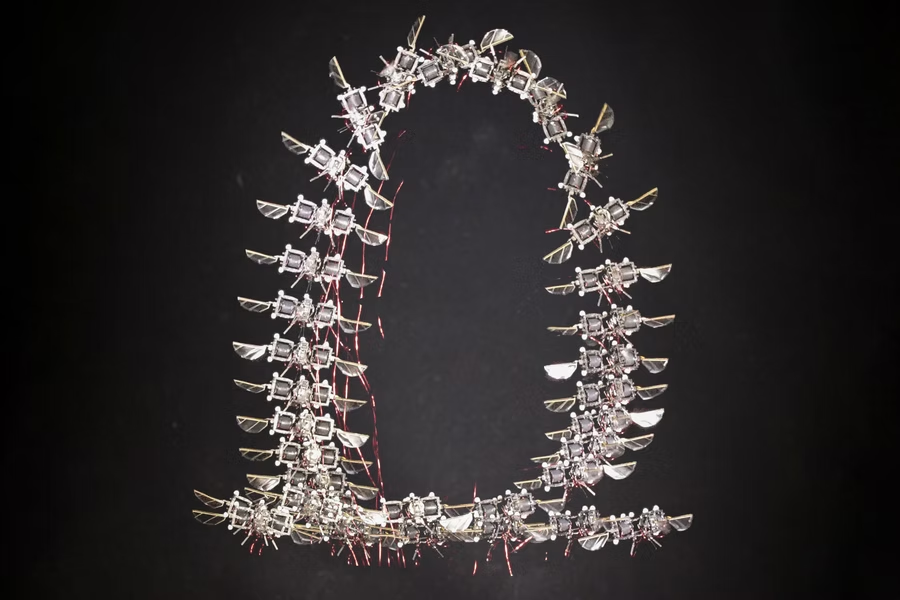
In the not-so-distant future, tiny flying robots could play a crucial role in disaster response, helping locate survivors trapped beneath rubble after earthquakes or other catastrophic events. Unlike larger drones, these microrobots could navigate tight spaces that are inaccessible to conventional machines, weaving through debris while avoiding obstacles and unstable structures—much like real insects.
Until now, aerial microrobots have been limited to slow, predictable flight paths, far from the rapid and agile maneuvers exhibited by living insects. A breakthrough by researchers at MIT is now changing that. Using an advanced AI-based control system, the team has created insect-scale flying robots capable of performing complex gymnastic maneuvers with unprecedented speed and agility. These robots can even execute multiple consecutive body flips, demonstrating a level of dexterity previously unseen in machines of their size.
“Traditional quadcopters cannot reach areas that insects can easily navigate,” explains Kevin Chen, associate professor in MIT’s Department of Electrical Engineering and Computer Science (EECS) and head of the Soft and Micro Robotics Laboratory within the Research Laboratory of Electronics. “With our bio-inspired control framework, the robot’s flight performance—its speed, acceleration, and pitching angle—is now comparable to insects. This represents a significant step toward deploying these robots in real-world scenarios.”
The collaborative effort involved a two-part control system that balances high-performance maneuverability with computational efficiency. By combining a powerful model-predictive controller with a deep-learning policy trained through imitation learning, the team enabled the robots to perform precise and rapid maneuvers in real time.
READ ALSO: https://www.modernmechanics24.com/post/mit-artificial-tendons-robot-boost
The approach increased the robots’ speed by about 447 percent and acceleration by 255 percent compared to earlier models. In one demonstration, a microrobot completed 10 somersaults in just 11 seconds, even while contending with wind disturbances.
Chen’s team has been developing robotic insects for over five years. The latest iteration is a microcassette-sized device, smaller than a paperclip, equipped with larger flapping wings for greater agility.
Powered by soft artificial muscles, these wings flap at extremely high frequencies, providing the force necessary for agile flight. However, controlling such lightweight, fast-moving robots is no small feat. The previous hand-tuned controllers limited performance and could not reliably execute aggressive flight maneuvers.
WATCH ALSO: https://www.modernmechanics24.com/post/chinese-company-s-humanoid-robot-dodges-arrow-with-side-flip
To overcome these challenges, Chen’s team partnered with Jonathan P. How, the Ford Professor of Engineering in MIT’s Department of Aeronautics and Astronautics, to design a two-step AI-driven control framework.
The first step uses a model-predictive controller to plan optimal trajectories while accounting for the robot’s constraints and external disturbances. While highly effective, this method is computationally intensive and cannot operate in real time on such small robots.
The second step uses imitation learning to compress the high-performance controller into a deep-learning policy capable of running in real time. The policy acts as the robot’s brain, taking position inputs and outputting control commands such as thrust and torque. By generating a carefully curated set of training data, the team ensured the robot could perform aggressive maneuvers safely and reliably.
READ ALSO: https://www.modernmechanics24.com/post/space-station-all-ports-occupied
In experiments, the robots demonstrated insect-like flight behaviors such as saccades—rapid accelerations and decelerations used by insects to stabilize themselves and gather visual information. These capabilities open the door to future robots equipped with onboard sensors and cameras, capable of flying outdoors without reliance on complex motion-capture systems. Researchers envision fleets of microrobots navigating collapsed buildings, avoiding collisions with each other, and coordinating their search efforts autonomously.
“This work is a paradigm shift for the micro-robotics community,” says Chen. “It shows that we can achieve both high performance and computational efficiency, even at tiny scales.” Sarah Bergbreiter, professor of mechanical engineering at Carnegie Mellon University, emphasizes the significance: “The robots perform precise flips and fast turns despite large fabrication tolerances, wind gusts, and tether constraints. Even though the controller currently runs externally, these results suggest that onboard AI control is feasible for insect-scale robots in the near future.”
WATCH ALSO: https://www.modernmechanics24.com/post/xlaserlab-e3-uv-game-changing-engraver
This research, published in Science Advances, was supported by the National Science Foundation, Office of Naval Research, Air Force Office of Scientific Research, MathWorks, and the Zakhartchenko Fellowship. By combining bio-inspired design with advanced AI, the MIT team is bringing the dream of agile, insect-like robots closer to reality—robots capable of performing life-saving missions in environments that were once completely inaccessible.