A team led by Los Alamos National Laboratory, working with Lawrence Livermore National Laboratory (LLNL), has successfully achieved fusion ignition at the National Ignition Facility. In an experiment conducted on June 22, the team produced 2.4 ± 0.09 megajoules of energy and created a self-sustaining “burning plasma,” a key milestone in fusion research.
“This demonstrates how effectively our designs can create fusion ignition conditions to help answer important stockpile stewardship questions,” said Joseph Smidt, a Los Alamos physicist and co-director of the lab’s inertial confinement fusion program.
The experiment also marked the first use of Los Alamos’ Thinned Hohlraum Optimization for Radflow (THOR) window diagnostic system. Adapted from LLNL’s ignition platform, this system generates intense X-ray output, which scientists can use to study how radiation flows through different materials and how much X-ray energy those materials absorb.
“This incredible achievement was only possible because of the teamwork involved,” said Ryan Lester, Los Alamos physicist and THOR campaign lead. “We made it happen in under a year thanks to everyone’s dedication. We moved quickly, worked together, and proved what’s possible when the whole team is aligned and committed.”
What is ignition?
Ignition occurs when a fusion reaction produces more energy than the amount of laser energy delivered to its target. Reaching this point creates extreme conditions, allowing scientists to study how materials behave under plasma environments that were once impossible to replicate in a laboratory. Lawrence Livermore National Laboratory first achieved ignition in 2022 and has repeated the feat several times since. This latest success opens new opportunities for exploring previously inaccessible areas of physics.
READ ALSO: Space Exploration Pioneers: Three Generations of Fruit Flies Born in China’s Space Station
READ ALSO: World’s next most powerful optical telescope enters into final design
“This experiment is an important step in confirming the accuracy of our high-fidelity simulations and proving that ignition-level performance is possible, even with the THOR platform modifications,” said Ryan Lester.
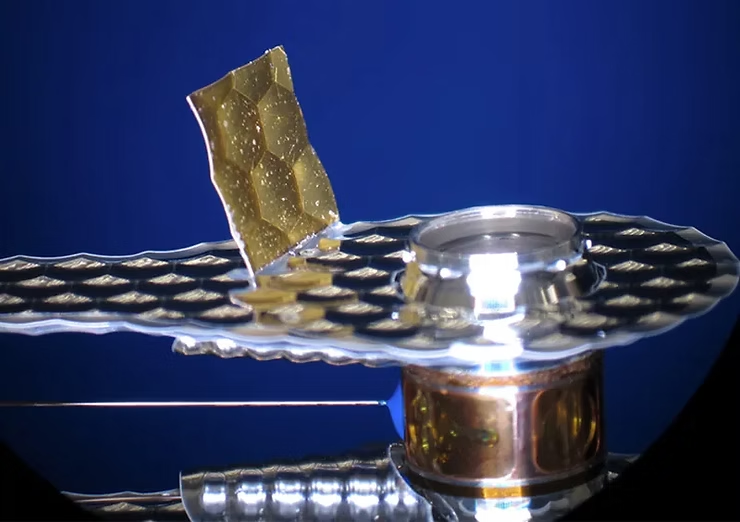
In a typical National Ignition Facility experiment, powerful lasers target a small, gold-coated cylinder called a hohlraum, only a few millimeters in size. Inside this hohlraum is a capsule containing deuterium and tritium — the fuels for fusion. When the lasers strike the hohlraum’s inner walls, they create an intense bath of X-rays. These X-rays cause the capsule to implode symmetrically, triggering fusion ignition.
How is THOR different?
THOR experiments use a hohlraum designed by Los Alamos National Laboratory (LANL), inspired by Lawrence Livermore National Laboratory’s ignition model but modified to include special windows. These windows allow some of the intense X-rays generated during the reaction to escape, providing a powerful source for testing how materials respond to extreme heat and radiation — a critical area of study for nuclear weapon scientists.
The main challenge was ensuring that these windows didn’t disrupt the hohlraum’s energy balance or the symmetry of the implosion — both essential for achieving fusion ignition.
READ ALSO: 0-100% in 12 minutes: Scientists fast charge lithium-sulfur batteries
“Igniting capsule implosions are extremely sensitive,” explained LANL physicist Brian Haines, who helped design the experiment and made key contributions to x-RAGE, the lab’s advanced modeling software for hohlraums and capsule implosions. “Any energy loss or disturbance can stop ignition, which would also prevent us from generating the X-ray flux we need as a source.”
Now that ignition has been achieved with a THOR design, the team’s next steps include exploring ways to make the windows even more transparent and creating experiments that can attach directly to them.
“This is a game-changing breakthrough that pushes forward both our fusion science and our 3D modeling capabilities,” said physicist Joseph Smidt. “Reaching this goal showcases LANL’s expertise in mastering such a complex and innovative platform.”