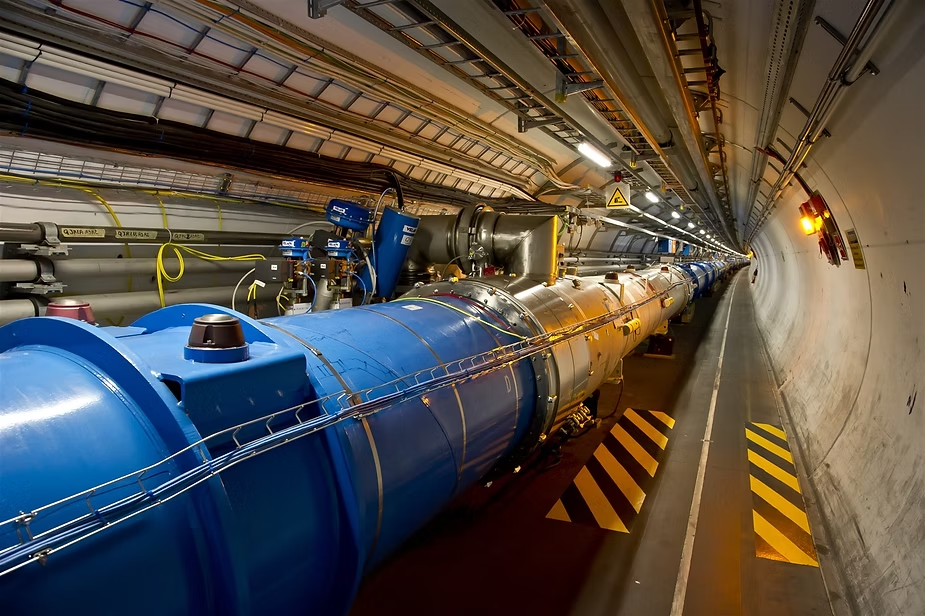
TIME magazine has announced that CERN’s Large Hadron Collider (LHC) has been selected as one of the 25 inventions to be inducted into the prestigious TIME Best Inventions Hall of Fame. Each year, TIME identifies the most groundbreaking innovations shaping the world in science, technology, and beyond. To mark the 25th anniversary of its Best Inventions list, TIME has revisited a quarter-century of innovation to highlight 25 inventions that have made the most significant and lasting impact on humanity.
Chosen for their originality, ambition, and influence, the LHC stands among these transformative creations that have redefined the limits of what is scientifically possible.
A Landmark in Scientific Innovation
When it began operations in 2008, the Large Hadron Collider became the world’s largest and most powerful particle accelerator—a technological marvel that represented decades of engineering achievement and scientific vision. The LHC was first included in TIME’s Best Inventions list that same year, recognized for its unprecedented ability to recreate the conditions of the early universe and probe the fundamental nature of matter.
The concept for the LHC was born in the early 1980s, at a time when many of the technologies needed to build such a vast and complex machine were still in their infancy. To bring the project to life, scientists and engineers had to pioneer advances in superconducting magnets, ultrahigh vacuums, and cryogenics, pushing the boundaries of what was technically possible.
A Global Collaboration for Discovery
What makes the LHC especially remarkable is the international collaboration that sustains it. Over the past two decades, thousands of scientists, engineers, and technicians from more than 110 countries have worked together at CERN to design, build, and operate this monumental experiment. Their efforts have not only advanced physics but have also driven innovation across computing, materials science, and data analysis.
READ ALSO: https://www.modernmechanics24.com/post/new-coastal-defense-deterrent-against-seaborne-threats
Since the collider’s first beams circulated in 2008, it has delivered a series of historic scientific achievements. In 2012, the LHC enabled the discovery of the Higgs boson, a fundamental particle long predicted by the Standard Model of particle physics. The confirmation of its existence filled in one of the final missing pieces of our understanding of how matter acquires mass—earning François Englert and Peter Higgs the Nobel Prize in Physics the following year.
Beyond the Higgs, the LHC has uncovered a “bestiary” of exotic hadrons, deepening our insight into the strong nuclear force and the behavior of quarks. Each run of the collider continues to probe new frontiers, testing the Standard Model and searching for phenomena beyond it, such as dark matter and supersymmetry.
WATCH ALSO: https://www.modernmechanics24.com/post/world-first-sea-skimming-drone-unveiled
A Lasting Legacy
TIME’s recognition of the LHC is not just a tribute to a single machine, but to the spirit of international scientific cooperation and relentless curiosity that it embodies. Nearly two decades since its first operation, the LHC continues to expand humanity’s understanding of the universe’s most fundamental building blocks—cementing its place among the most significant inventions of modern times.