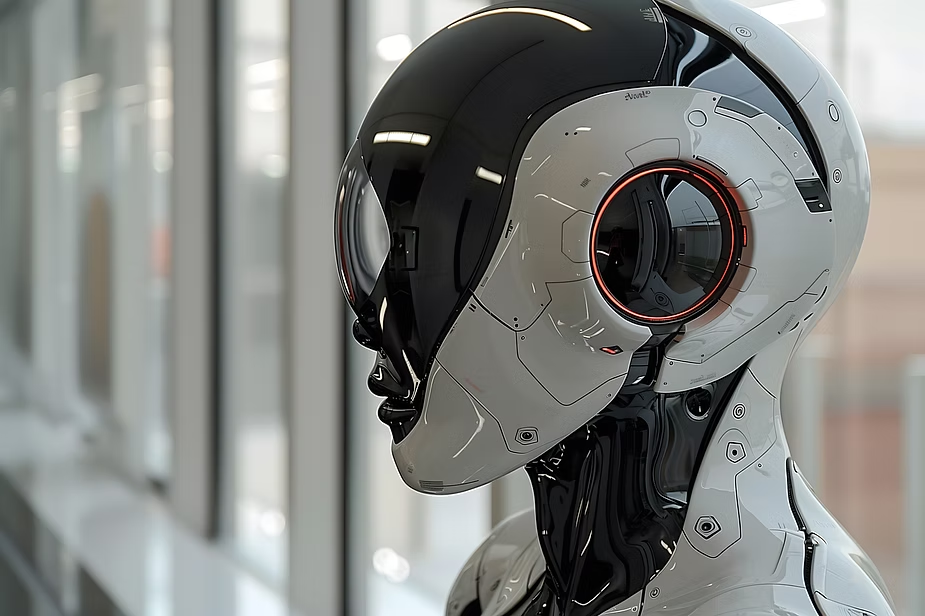
UBTech Robotics has secured a 264 million yuan (US$37 million) contract to deploy its industrial-grade Walker S2 humanoid robots at border crossings between China’s Guangxi region and Vietnam. The world’s first humanoid capable of replacing its own battery will perform traveler guidance, inspections, and logistics operations, with deliveries beginning in December as China intensifies robotics commercialization.
Imagine arriving at a bustling border crossing and being greeted not by overwhelmed staff, but by sophisticated humanoid robots capable of guiding you through procedures, conducting security inspections, and even managing logistics—all while being able to swap their own batteries when power runs low. This futuristic scenario is becoming reality at the China-Vietnam border, thanks to a major new robotics deployment.
UBTech Robotics, one of China’s leading robot manufacturers, announced on Tuesday that it had secured a substantial 264 million yuan (US$37 million) deal to deploy humanoid robots at border crossings in Fangchenggang, a coastal city in China’s southern Guangxi region that shares a border with Vietnam. The contract represents a significant step in China’s push to integrate advanced robotics into real-world applications beyond factory settings.
The initiative will feature UBTech’s industrial-grade Walker S2 model, launched in July and billed as the world’s first humanoid robot capable of replacing its own battery. This groundbreaking self-maintenance capability allows for extended operational periods without human intervention, making the robots particularly suitable for 24/7 border operations.
READ ALSO: https://www.modernmechanics24.com/post/powerline-sag-detection-hanyang
According to the announcement, the pilot program will see humanoid robots deployed at borders to assist with traveler guidance, personnel flow management, patrols, logistics operations, and commercial services. The robots will also conduct inspections at manufacturing sites for steel, copper, and aluminium, demonstrating their versatility across different operational environments.
UBTech expects to begin deliveries in December, reported the South China Morning Post. The company’s chief branding officer Michael Tam revealed in an interview that UBTech was on target to deliver 500 industrial humanoid robots by year-end, with plans to increase production tenfold by next year and reach 10,000 units by 2027.
The border deployment is part of a broader national trend as China’s robotics industry races to commercialize embodied artificial intelligence, supported by government policies. Cumulative orders for the Walker series, which started shipping this month, total 1.1 billion yuan so far, according to UBTech.
WATCH ALSO: https://www.modernmechanics24.com/post/chinese-humanoid-robot-picks-tennis-ball
What makes this deployment particularly significant is how it represents the expanding applications of humanoid robotics beyond traditional manufacturing roles. “The deployment is part of a broader national trend, as China’s robotics industry races to commercialise embodied artificial intelligence, supported by government policies,” noted the South China Morning Post report.
This isn’t an isolated case of robotics integration in Chinese public services. In July, the immigration department of Zhejiang province published a WeChat post highlighting its adoption of humanoids and four-legged robots, including those from Hangzhou-based Unitree Robotics. The agency stated these machines could “perform repetitive and tedious daily duties” to help “save manpower.”
Similarly, at Hangzhou Xiaoshan International Airport, a robot has been deployed to handle routine tasks such as answering passenger inquiries. During this year’s Shanghai Cooperation Organisation Summit in Tianjin, immigration authorities deployed a multilingual robot developed by Beijing-based iBen Intelligence.
READ ALSO: https://www.modernmechanics24.com/post/uss-massachusetts-submarine-delivery-us-navy
The trend extends beyond border and airport settings. Shenzhen Customs has integrated leading AI start-up DeepSeek’s large language model into an inspection robot designed to identify and verify cargo information. Police patrol robots have also become increasingly common on the streets of Shenzhen, Shanghai, and Chengdu, frequently showcased in Chinese media as symbols of the nation’s growing embodied intelligence industry.
The government’s commitment to this technological push was further demonstrated on Monday when China’s Ministry of Industry and Information Technology released a list of members for its national humanoid robotics committee, led by the regulator’s chief engineer Xie Shaofeng. The committee includes prominent figures from China’s robotics sector, including Unitree founder Wang Xingxing, AgiBot co-founder Peng Zhihui, and UBTech technology chief Xiong Youjun.
As UBTech moves forward with its ambitious production plans and cost-reduction efforts, the border deployment represents a significant test case for how humanoid robots can enhance efficiency in complex public service environments. With the company also announcing a share placement plan to raise HK$3.11 billion (US$399.6 million) in Hong Kong to support its expansion, the China-Vietnam border may soon become a showcase for the future of automated border management.
WATCH ALSO: https://www.modernmechanics24.com/post/mono-rail-arunachal-army-innovation-16000ft