Dried fruit is a popular snack and recipe ingredient, but most dehydration methods rely on heat—consuming significant energy and sometimes compromising quality. Now, researchers reporting in ACS Food Science & Technology have unveiled a sustainable alternative: a system that removes water at room temperature using controlled air pressure and food-safe calcium chloride.
In a proof-of-concept, the team successfully dried mango and apple slices to commercial standards without applying heat. Conventional dehydrators use circulated hot air—fast but energy-intensive—while sun drying uses free solar energy but is slow and often discolors the fruit. To address these issues, Luis Bastarrachea and colleagues tested calcium chloride, a moisture-absorbing salt used in cheese making and molecular gastronomy, in a room-temperature dehydration chamber.
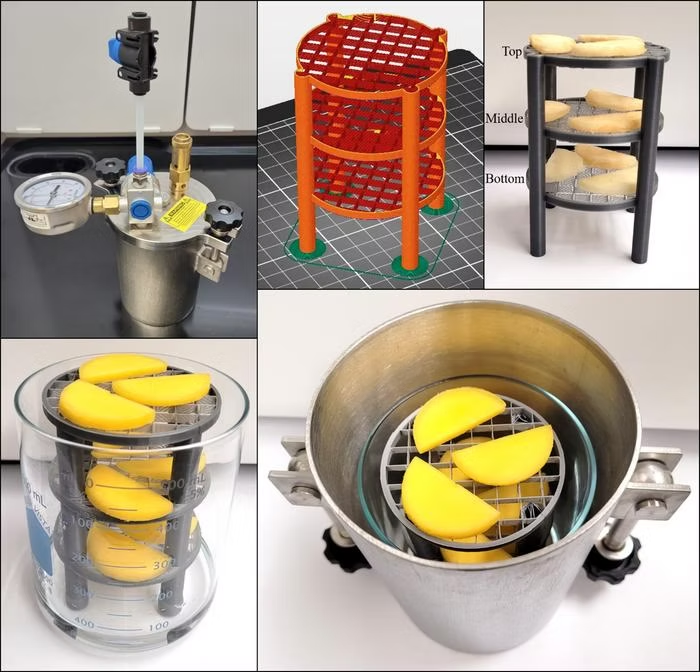
The chamber featured three mesh screens positioned above a container of calcium chloride solution. Mango and apple slices were placed on the screens, and two drying conditions were compared: standard air pressure and a slight vacuum.
After four days, the vacuum-assisted method proved far more effective. Fruits dried under standard pressure retained inconsistent moisture—50–70% for slices on the top screen and 20–30% for those on the bottom—while vacuum-dried pieces reached a consistent 30% moisture content, matching that of commercial dried fruit and representing a 95% reduction from their starting water content. Notably, vacuum-dried mango maintained its vibrant yellow color, while apples darkened equally under both methods.
READ ALSO: NASA Trials Innovative Supersonic Parachute Delivery Technology
READ ALSO: Arizona Scientists Uncover the Wanderlust of America’s Iconic Bald Eagles
Microscopy revealed starch granule breakdown in all samples, but this was more pronounced under standard pressure, suggesting that vacuum-assisted drying helps slow deterioration and preserve quality.
The researchers also noted that the water removed could be reclaimed: calcium chloride solutions can be reconcentrated and reused for multiple drying cycles, with the collected water potentially repurposed for industrial processes or treated for human consumption.
This approach could pave the way for energy-efficient, scalable, and color-preserving fruit preservation—one that saves both resources and flavor.