Purdue University engineers have developed a straightforward optical method that reveals a battery’s internal health by watching individual particles light up during charging. Using a simple RGB camera and microscope, the team, led by Professor Kejie Zhao, can now assess charge distribution across hundreds of particles at once, providing a critical new window into battery safety and performance.
For a world increasingly reliant on lithium-ion batteries, from smartphones to electric vehicles, understanding their internal health is paramount. Current methods of quality control are limited, often providing an incomplete picture of what’s happening at the microscopic level where performance is truly determined. The new technique from Purdue University offers a surprisingly simple and powerful alternative.
“Lithium-ion batteries — in fact, all batteries — function because of millions of chemical interactions happening at the particle level,” explained Professor Kejie Zhao. The challenge has always been observing these interactions directly and at scale. The breakthrough, reported in Proceedings of the National Academy of Sciences (PNAS), lies in a recently discovered optical phenomenon: as battery particles charge, they glow brighter.
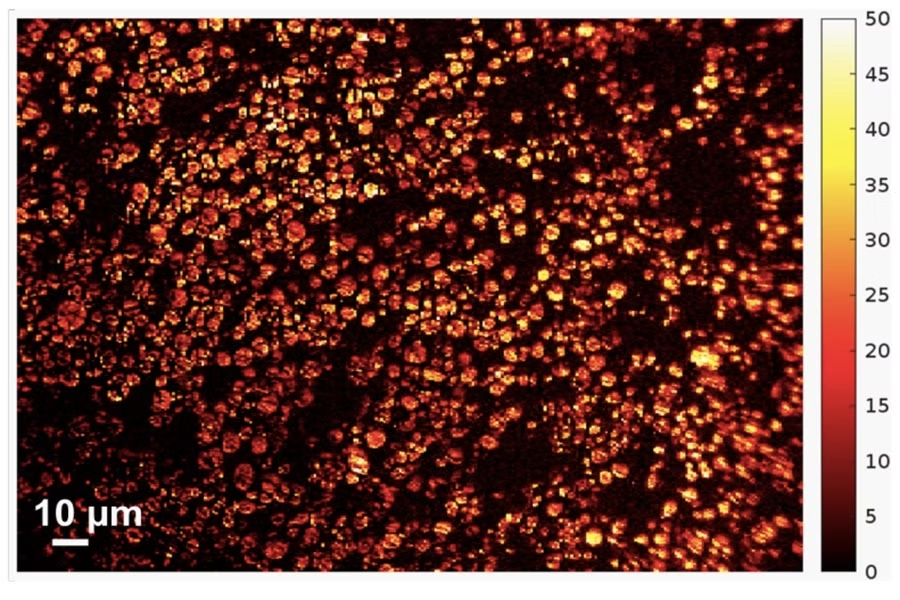
“It’s only been recently discovered that individual particles in a battery’s electrode actually appear brighter as they charge,” Zhao stated. “Our breakthrough is that we look at hundreds of particles at a time, and can use their brightness levels to determine how evenly the charge is distributed through the electrode.” This ability to monitor a large population of particles simultaneously is what sets this method apart.
READ ALSO: https://www.modernmechanics24.com/post/electric-road-charges-vehicles-while-driving
The experimental setup is remarkably accessible. The team placed a standard lithium-ion coin cell battery in a protective glove box and trained a simple optical microscope on a field of view containing between 100 and 1,000 individual particles. As they slowly charged the battery, a standard camera recorded time-lapse video. By meticulously tracking the changing brightness of each particle, they could reconstruct a precise spatial map of the charge within the electrode.
One of the most surprising aspects, according to Professor Zhao, is the technique’s robustness. “The amazing part about this process is that you don’t need high-powered tools — just a simple optical microscope and camera,” he said. “It doesn’t even need to be in focus; the brightness levels consistently deliver accurate data either way.” This accessibility could make the method highly attractive for both research and industrial quality control.
Through sophisticated image processing, the team established a direct mathematical link between a particle’s glow and its electrochemical state. “We’ve established that there is a direct mathematical correlation between the optical brightness of particles and the overall state of charge of the battery,” Zhao confirmed, according to the team’s published research. This correlation is the key to diagnosing battery health.
WATCH ALSO: https://www.modernmechanics24.com/post/chinese-firm-unveils-humanoid-robot-that-mimics-meditation
Why does this matter so much? A battery’s longevity and safety hinge entirely on heterogeneity—or how evenly charge and discharge reactions are spread across its electrode material. When charge becomes concentrated in localized clusters, it creates stress points. “If charge is concentrated in one place, the battery is more likely to degrade, fail, or even burn catastrophically,” Zhao warned. This unevenness can initiate local defects that cascade into degraded performance or, in the worst case, thermal runaway and fire.
This new optical method provides a direct, visual way to spot these dangerous heterogeneities early. It could revolutionize how batteries are tested during manufacturing and how their health is monitored throughout their lifespan, paving the way for safer, more reliable, and longer-lasting energy storage for everything from consumer electronics to the power grid.
READ ALSO: https://www.modernmechanics24.com/post/advanced-space-armor-stops-fast-debris