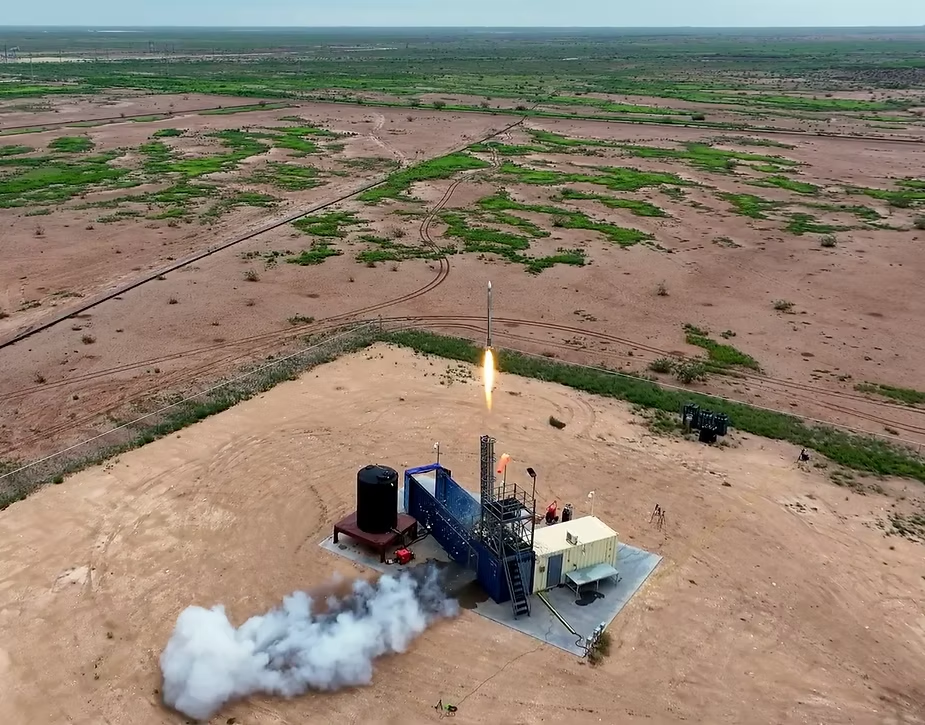
Firehawk Aerospace a leading innovator in energetics systems for defense, has successfully completed the first flight test of its GMLRS-class Firehawk Analog (GFA)—a groundbreaking 3D-printed hybrid rocket engine system. The achievement marks a major milestone under Firehawk’s ongoing Phase III Small Business Innovation Research (SBIR) contract with the U.S. Army Applications Laboratory (AAL).
A New Era of Hybrid Rocket Propulsion
The test demonstrated Firehawk’s ability to additively manufacture hybrid propulsion systems designed for tactical applications. Launched from a custom-built mobile platform, the rocket system achieved a vertical ascent exceeding 18,000 feet while surpassing the speed of sound.
Equally important, the flight showcased directional stability and strong thrust performance, proving the system’s reliability under demanding conditions. The results highlight the potential of hybrid propulsion to deliver new levels of adaptability, cost-efficiency, and rapid production—capabilities made possible by additive manufacturing.
“This milestone proves that hybrid propulsion systems, when paired with advanced additive manufacturing, have a real place in the future of tactical systems,” said Will Edwards, CEO of Firehawk Aerospace. “To design, develop, and launch the first-ever GMLRS form-factor hybrid propulsion system underscores the strength and innovation of our engineering team and the scalability of our technology.”
Why It Matters
Hybrid propulsion, which combines features of both solid and liquid rocket systems, has long been recognized for its potential advantages. These include increased safety, improved performance, and easier throttling, making hybrids more versatile than traditional solid motors.
By integrating 3D-printing technologies into the design and manufacturing process, Firehawk is further pushing the boundaries of what hybrid systems can achieve. Additive manufacturing allows for complex geometries, reduced production times, and streamlined supply chains—all critical factors as the Department of Defense seeks faster, more adaptable solutions to meet evolving mission needs.
READ ALSO: https://modernmechanics24.com/post/large-coin-find-from-roman-times-in-bunnik
The GFA Test Program
The GFA (GMLRS-class Firehawk Analog) test is the first in a planned series of demonstrations under the AAL contract. Each flight is designed to validate the scalability of Firehawk’s hybrid propulsion technology across different missile and rocket platforms.
Following the successful GFA demonstration, Firehawk will conduct tests of its Javelin-class and Stinger-class analogs. These systems are being developed as drop-in replacements for legacy solid rocket motors used in existing Department of Defense (DoD) weapon systems. By offering form-factor compatibility, Firehawk’s hybrid alternatives could potentially integrate into current military platforms without requiring extensive redesigns.
A Step Toward the Future of Defense Technology
The success of the GFA flight test underscores Firehawk’s position as a pioneer in next-generation propulsion. As the U.S. military increasingly looks for solutions that combine performance, safety, and affordability, hybrid propulsion stands out as a strong candidate.
With additive manufacturing, Firehawk is not only demonstrating technical feasibility, but also showing that these systems can be produced quickly and cost-effectively—two qualities critical for scaling production in response to emerging defense requirements.
READ ALSO: https://www.modernmechanics24.com/post/iberian-nailed-head-ritual-was-more-complex-than-expected
Looking Ahead
Firehawk Aerospace’s roadmap includes continued development and demonstration of its hybrid propulsion systems across multiple classes of tactical missiles and rockets. Each successful test brings the technology closer to operational deployment, reinforcing the company’s commitment to delivering innovative, mission-ready solutions for the defense sector.
As Edwards emphasized, the GFA achievement is more than just a test flight:
“This is a demonstration of what’s possible when advanced materials, additive manufacturing, and hybrid propulsion come together. We’re proving that the future of tactical rocket systems can be safer, faster, and more efficient than ever before.”
With its first successful flight demonstration complete, Firehawk Aerospace has positioned itself at the forefront of propulsion innovation—paving the way for a new generation of tactical systems designed to meet the evolving needs of the U.S. Army and beyond.