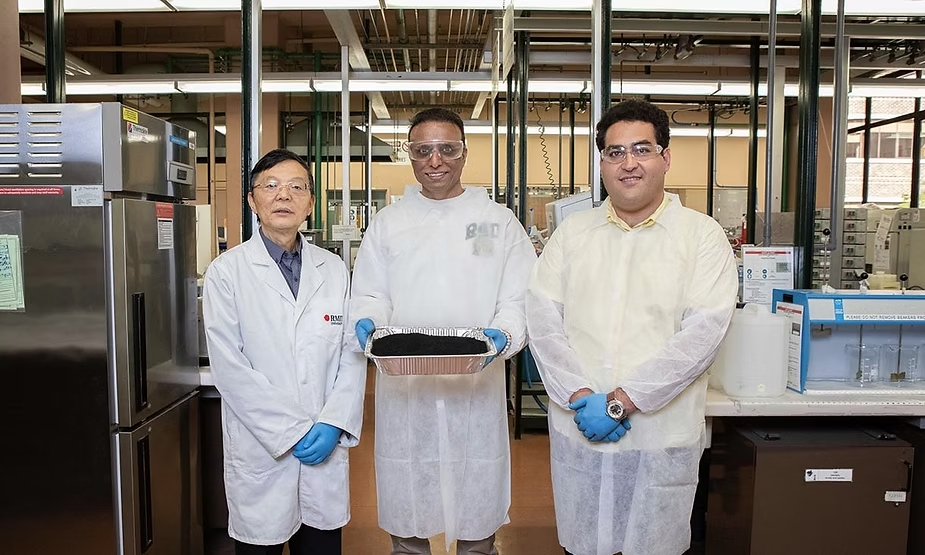
RMIT University engineers have developed a groundbreaking method to reduce concrete’s carbon footprint by incorporating biochar made from spent coffee grounds. Led by Dr. Jingxuan Zhang and Dr. Mohammad Saberian, the research demonstrates for the first time through comprehensive life-cycle analysis that coffee biochar can achieve carbon dioxide reductions of up to 26 percent while actually strengthening the concrete.
The innovative approach addresses two environmental challenges simultaneously: the massive carbon emissions from concrete production and the growing problem of organic waste. The RMIT team discovered that when spent coffee grounds are heated to 350 degrees Celsius without oxygen, they transform into a fine biochar that can replace a portion of the sand typically used in concrete mixtures. Earlier laboratory tests showed that replacing 15 percent of sand with this coffee-derived biochar resulted in a 30 percent increase in 28-day concrete strength.
What makes this new study particularly significant is the comprehensive life-cycle assessment conducted by the researchers. Unlike previous studies that focused only on laboratory performance, this cradle-to-grave analysis examined the complete environmental impact from raw material extraction through manufacturing, use, and final disposal. The results revealed impressive environmental benefits beyond just carbon reduction, including up to 31 percent lower fossil fuel consumption and reduced impacts on freshwater ecosystems.
READ ALSO: https://www.modernmechanics24.com/post/china-lunar-soil-bricks-return
“The findings strengthened the case for real-world trials,” explained Dr. Jingxuan Zhang from RMIT’s School of Engineering. “We showed that coffee biochar can cut concrete’s carbon footprint in the scenarios we assessed, while earlier trials demonstrated strength gains using the same approach.” This dual benefit of reduced environmental impact and improved performance makes the coffee biochar concrete particularly attractive for sustainable construction.
The research team, which received guidance from Professor Chun-Qing Li, has been actively engaging with industry partners and government agencies to move the technology from the laboratory to practical applications.
“Using moderate amounts of coffee biochar offers a clear, measurable pathway to lower-impact concrete,” stated Professor Li. The innovation aligns perfectly with Australia’s transition toward a circular economy and net-zero emissions goals by transforming waste streams into valuable construction materials.
WATCH ALSO: https://www.modernmechanics24.com/post/byd-seal-smooth-electric-power
According to Dr. Mohammad Saberian, the next steps involve scaling up the technology through larger pilot projects and optimizing concrete mixtures to meet industry standards. “We welcome collaboration on supply chains and field deployments,” he said, emphasizing the team’s commitment to practical implementation.
The researchers have already demonstrated the concept in real-world settings, including a footpath pilot and the first coffee-biochar concrete section installed as part of the Victorian Big Build infrastructure program.
The potential impact extends beyond just environmental benefits. With global concrete production consuming approximately 50 billion tonnes of sand annually—making it the world’s second most exploited resource after water—finding sustainable alternatives represents an urgent priority. Coffee biochar not only reduces pressure on natural sand supplies but also provides a valuable use for the massive quantities of spent coffee grounds generated worldwide each day.
READ ALSO: https://www.modernmechanics24.com/post/lithium-waste-into-super-strong-concrete
The concept has already captured public imagination through exhibitions like the National Gallery of Victoria’s “Making Good: Redesigning the Everyday,” showcasing how innovative thinking can transform everyday waste into functional, sustainable materials.
As construction industries worldwide seek ways to reduce their environmental footprint, the RMIT research offers a practical solution that turns morning coffee waste into tomorrow’s infrastructure, proving that sustainability and strength can indeed go hand in hand.
WATCH ALSO: https://www.modernmechanics24.com/post/robot-dogs-explosives-china-battle-drill