A new study by Chinese scientists has uncovered how fluctuations in marine sulfate concentrations can act as a “geochemical switch,” altering the way methane is consumed on the seafloor and influencing Earth’s long-term climate stability. The findings, published in Nature Geoscience, shed light on ancient climate events and raise concerns about similar mechanisms being triggered in today’s warming Arctic Ocean.
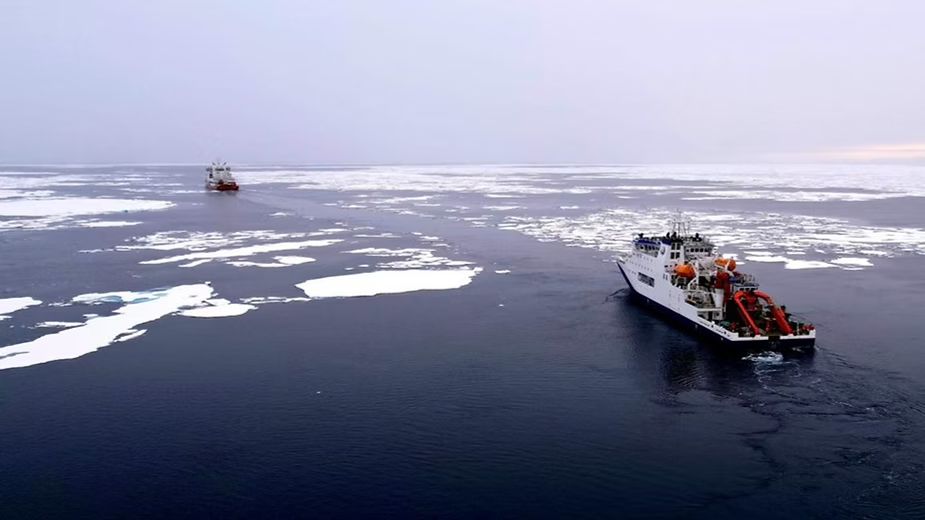
Researchers from the Guangzhou Institute of Geochemistry (GIG) at the Chinese Academy of Sciences (CAS) explained that changes in ocean chemistry could drastically shift how methane — one of the most potent greenhouse gases — is processed in marine environments. They warned that such a geochemical tipping point could re-emerge as the Arctic continues to warm and freshen at an unprecedented rate due to melting ice and increased freshwater inflow.
The study draws parallels to a dramatic episode in Earth’s history known as the Paleocene–Eocene Thermal Maximum (PETM), which occurred about 56 million years ago. During this period, global temperatures spiked, and the oceans became increasingly acidic — conditions that mirror today’s accelerating climate crisis.
Methane, the second most important greenhouse gas after carbon dioxide, exists in vast quantities trapped beneath the ocean floor. Scientists have long feared that as temperatures rise, this stored methane could escape into the atmosphere, intensifying global warming. However, recent research indicates that most of this methane never reaches the surface. Instead, it dissolves into seawater, where microbial communities “digest” it, converting it into less harmful compounds.
According to Professor Zhang Yige of GIG, these methane-eating microbes use sulfate ions as their energy source, or “fuel,” efficiently breaking down methane while producing alkaline by-products. These reactions not only limit methane emissions but also help buffer the ocean against acidification.
WATCH ALSO: https://www.modernmechanics24.com/post/airless-steel-wheels-mining-truck-revolution
But the new study reveals that during the PETM, sulfate levels in Arctic waters were less than one-third of what they are today. With sulfate in short supply, the balance shifted. Instead of being consumed by microbes deep in the sediment, methane began diffusing into the upper ocean layers, where aerobic bacteria rapidly oxidized it. This “flash-burn” of methane generated a burst of carbon dioxide, significantly raising CO₂ concentrations in Arctic waters.
The researchers found that during this ancient warming event, the Arctic Ocean transformed from a carbon sink — a “sponge” that absorbed CO₂ — into a carbon source, or “chimney,” releasing it back into the atmosphere. This reversal likely amplified global warming during that time.
READ ALSO: https://www.modernmechanics24.com/post/nobel-chem-2025-kitagawa-yaghi-robson
The findings suggest that similar processes could occur again as modern Arctic conditions evolve. If sulfate levels drop due to increased freshwater input from melting ice, the delicate balance that currently keeps methane emissions in check could be disrupted.
“Our study highlights the potential for major perturbations to the Arctic carbon cycle under future climate change,” the authors noted, emphasizing the importance of monitoring chemical shifts in the world’s polar oceans.