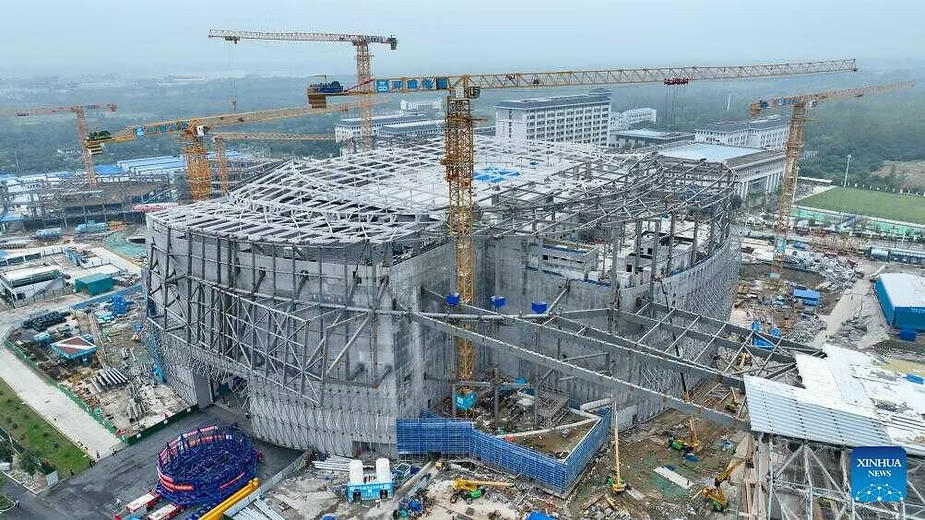
China’s efforts to unlock the potential of fusion power have taken a significant step forward. The Burning Plasma Experimental Superconducting Tokamak (BEST), a compact fusion device under construction in Hefei, Anhui Province, has successfully completed the installation of its first major component — the Dewar base. The achievement marks an important milestone toward China’s long-term goal of realizing electricity generation from fusion energy.
Fusion, the same process that powers the sun, has long been regarded as the “ultimate energy source.” By fusing light atomic nuclei to release massive amounts of energy, it offers the promise of virtually limitless, clean power without the long-lived radioactive waste associated with conventional nuclear fission. The BEST project aims to bring that promise closer to reality by demonstrating sustained “burning” of deuterium-tritium plasma — a feat that would represent a leap forward from existing fusion experiments.
At the center of this ambitious device is the Dewar, a crucial component that acts as a massive, high-vacuum thermos. It is designed to insulate the superconducting magnets that operate at an ultra-cold temperature of minus 269 degrees Celsius, while simultaneously containing plasma that reaches over 100 million degrees. This delicate balance of extreme conditions is what allows the magnetic field to confine the plasma and sustain fusion reactions.
According to Huang Xiongyi, associate researcher at the Institute of Plasma Physics under the Chinese Academy of Sciences, the newly installed Dewar base forms the structural foundation for the entire reactor. “It will ultimately support more than 6,000 tonnes of equipment,” Huang said. The base itself weighs over 400 tonnes, measures approximately 18 meters in diameter and five meters in height, and stands as the heaviest and largest vacuum component ever built for fusion research in China.
Building the Dewar base was no small task. Engineers had to achieve breakthroughs in multiple cutting-edge manufacturing areas, including high-precision forming and welding, millimeter-level deformation control, and ultra-high vacuum sealing technology. Despite the challenges, the team managed to complete the installation with remarkable precision — achieving alignment accuracy within a few millimeters.
READ ALSO: https://www.modernmechanics24.com/post/ultra-precise-gps-coming-to-cars
WATCH ALSO: https://www.modernmechanics24.com/post/tesla-optimus-robot-serves-popcorn-in-us
Since full-scale assembly of the BEST facility began in May 2025, the project has drawn widespread public and scientific interest, symbolizing China’s growing capability in advanced energy research. Once completed, BEST will serve as a vital testbed for developing technologies necessary for practical fusion power generation.
With the successful installation of the Dewar base, assembly of other major components — including the superconducting magnet system and plasma chamber — will proceed in stages. The entire device is expected to be completed by the end of 2027.
Researchers believe that once operational, BEST will not only enhance China’s position in the global fusion race but also contribute valuable data and engineering experience toward building future fusion power plants capable of supplying clean, sustainable electricity to the grid.
WATCH ALSO: https://www.modernmechanics24.com/post/tesla-model-y-drives-australia-without-driver