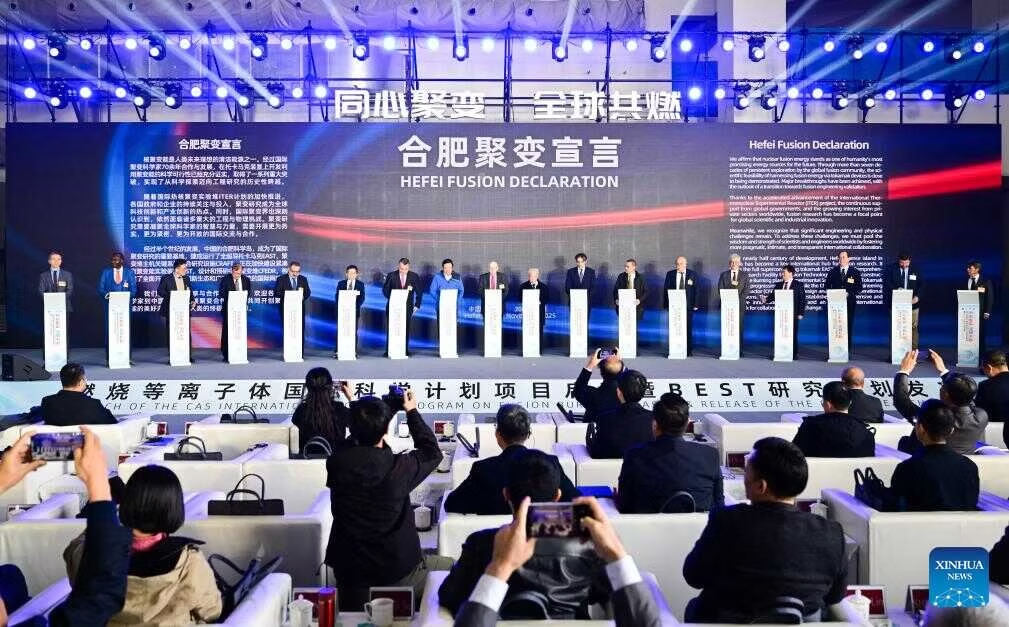
Credit: Xinhua/Zhou Mu
China on Monday launched a major international scientific initiative in Hefei, the capital of Anhui Province, designed to advance research on fusion burning plasma—a key step toward realizing practical fusion energy.
The program opens several of China’s state-of-the-art fusion research platforms to global scientists, fostering collaboration in one of the most ambitious energy projects of the 21st century.
The initiative is spearheaded by the Chinese Academy of Sciences’ Institute of Plasma Physics (ASIPP), which will provide international researchers access to multiple cutting-edge facilities, including the Burning Plasma Experimental Superconducting Tokamak (BEST) in Hefei.
BEST, often referred to as China’s next-generation “artificial sun,” is expected to play a central role in upcoming deuterium-tritium fusion experiments aimed at generating net energy gain.
At the launch event, fusion scientists from more than ten countries—including France, the United Kingdom, and Germany—signed the Hefei Fusion Declaration. The declaration emphasizes open science, international cooperation, and the shared goal of accelerating global fusion research.
This marks a significant step in positioning China as a hub for collaborative fusion studies, inviting researchers worldwide to contribute their expertise to this rapidly evolving field.
Fusion energy, which mimics the process powering the sun, is considered one of the most promising sources of clean, virtually limitless energy. Creating the extreme conditions required for fusion has challenged scientists for decades, relying on methods like magnetic confinement to sustain the reactions.
WATCH ALSO: https://www.modernmechanics24.com/post/chinese-pan-jianwei-s-team-pan-jianwei-quantum-shield
A burning plasma, in particular, is a milestone stage where the heat generated by the fusion reaction itself maintains the reaction, laying the foundation for continuous energy production.
“We are entering a new era of burning plasma research, which is essential for future fusion engineering,” said Song Yuntao, vice president of the Hefei Institutes of Physical Science and director of ASIPP. “Achieving a self-sustained burning plasma is a critical step toward building practical fusion power plants.”
China’s fusion program has made rapid strides in recent years, repeatedly breaking world records in plasma confinement and energy output. The BEST device, scheduled for completion by the end of 2027, will conduct high-power experiments targeting 20 to 200 megawatts of fusion energy.
READ ALSO: https://www.modernmechanics24.com/post/russian-a60-laser-jet-destroyed
According to Song, while the challenges are immense—spanning engineering, physics, and materials science—the integration of China’s superconducting tokamak technology with international expertise offers unprecedented opportunities for progress.
“This international collaboration combines our technological strengths with global knowledge, pushing the frontiers of fusion physics,” Song added, highlighting the program’s vision of shared scientific advancement.