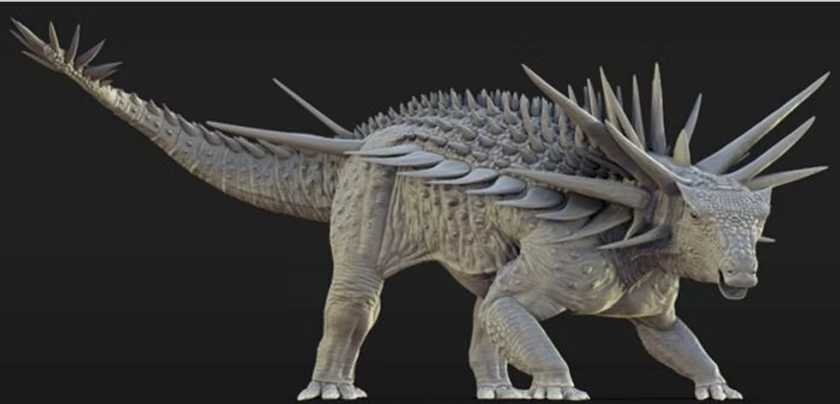
New fossil discoveries show that ankylosaurs—the heavily armoured “tanks” of the dinosaur world—developed their iconic tail weapons far earlier than previously believed.
In a study published in Nature [link], researchers describe Spicomellus afer, an unusual Jurassic ankylosaur that lived more than 165 million years ago near what is now Boulemane, Morocco. Remarkably, it possessed a tail weapon at least 30 million years before any other known ankylosaur, as well as a striking bony collar adorned with metre-long spikes jutting from either side of its neck.
This makes Spicomellus the earliest known ankylosaur and the first of its kind discovered on the African continent.
A Dinosaur Like No Other
The first description of Spicomellus in 2021 was based on a single rib bone. Now, new fossil material has revealed just how extraordinary this dinosaur was. Its ribs were fused with long spikes—some measuring 87 centimetres—that projected outward from a protective collar encircling its neck. This kind of armour has never been documented in any other living or extinct vertebrate.
Professor Susannah Maidment of the Natural History Museum and the University of Birmingham, who co-led the research, explained:
“Finding such elaborate armour in such an early ankylosaur changes our understanding of their evolution. It shows how important Africa’s dinosaurs are, and why we need to keep studying them.”
The armour extended far beyond the neck. According to Maidment, Spicomellus carried “a diversity of plates and spikes covering its entire body, including metre-long neck spikes, large spikes over the hips, and a mix of blade-like and paired spikes along the shoulders. We’ve never seen anything like this before in any animal.”
Strikingly, none of these flamboyant features appear in later ankylosaurs.
READ ALSO: https://www.modernmechanics24.com/post/ga-asi-yfq42a-collaborative-combat-aircraft-flight
READ ALSO: https://www.modernmechanics24.com/post/succulents-that-glow-after-sunlight
A Spine-Tingling Discovery
Professor Richard Butler of the University of Birmingham, also a project co-lead, recalled his first reaction:
“Seeing and studying the Spicomellus fossils for the first time was spine-tingling. We just couldn’t believe how strange it was. It turns much of what we thought we knew about ankylosaurs on its head and shows just how much there is still to learn about dinosaur evolution.”
The elaborate spikes may have been used more for display—attracting mates or intimidating rivals—than for protection. Later ankylosaurs, facing the rise of giant predators like advanced theropods, crocodiles, and snakes, evolved simpler, more defensive armour.
Tail Weapons Ahead of Their Time
Although the very tip of Spicomellus’ tail has not been recovered, fossil evidence suggests it carried a formidable weapon. The preserved tail vertebrae are fused into a rigid structure known as a “handle,” a feature only seen in ankylosaurs that wielded heavy tail clubs. Until now, such adaptations were thought to have evolved millions of years later, in the Cretaceous.
This combination of body armour, hip shields, and a possible tail club shows that many of the signature traits of ankylosaurs were already in place much earlier than once assumed.
READ ALSO: https://www.modernmechanics24.com/post/insect-inspired-fans-boost-mini-robots
READ ALSO: https://www.modernmechanics24.com/post/rtx-ltamds-radar-proves-360-degree-missile-defense
Expanding the Map of Dinosaur Evolution
The find also highlights the global spread of ankylosaurs and the crucial role of Africa in understanding their history. Professor Driss Ouarhache of Université Sidi Mohamed Ben Abdellah, who co-led the Moroccan team, noted:
“This study is helping to advance Moroccan science. Dinosaurs like Spicomellus are unlike anything we’ve seen before, and this region has much more to reveal.”
The fossils were carefully cleaned and prepared at the Department of Geology, Dhar El Mahraz Faculty of Sciences in Fez, Morocco, using specialist equipment provided by the University of Birmingham. They are now permanently stored and catalogued there.